Arabi Facts Hub
is a nonprofit organization dedicated to research mis/disinformation in the Arabic content on the Internet and provide innovative solutions to detect and identify it.
Coordinated Digital Clash Erupts Online Between Kuwaiti and Iraqi Accounts Over Khawr Abdullah
Mar. 11, 2026 | AFH
Simultaneously with the escalation of the dispute between Iraq and Kuwait over Khawr Abdullah, social media platforms witnessed an intense wave of digital activity, as the hashtags associated with the issue turned into an arena of crossfire between Iraqi and Kuwaiti accounts. This report tracks how the maritime conflict extended into the digital space.
Tensions over maritime border demarcation, specifically concerning the Khawr Abdullah area, resurfaced between Iraq and Kuwait in late February 2026. The political friction was sparked by Kuwait summoning the Chargé d'Affaires of the Iraqi Embassy on February 21 to protest Baghdad's submission of a map and lists of coordinates to the United Nations. Kuwait viewed this submission as an encroachment on its maritime sovereignty. Iraq, however, defended its action, stating that the coordinates had been deposited on January 19 and February 9, 2026, in accordance with the United Nations Convention on the Law of the Sea.
Coinciding with the diplomatic escalation, we monitored intensive digital activity surrounding the hashtags related to the file, in which Kuwaiti and other Gulf accounts participated, using hashtags including #العراق_لازم_يتأدب (Iraq must be taught a lesson), #خور_عبدالله_الكويتي (Kuwaiti Khawr Abdullah), and #حقل_الدره (Al-Durra field), in contrast to opposing Iraqi hashtags such as #خور_عبدالله_عراقي (Khawr Abdullah is Iraqi). This activity reflects a clear state of polarization in the discourse, with the circle of interaction widening outside the two countries.
The data recorded during the monitoring period shows that the number of posts associated with the hashtags reached about 3,500 posts, achieving an estimated reach of nearly 2.5 billion times, and about 48 million interactions, indicators that are not numerically consistent with the volume of published content, and the reach curve does not match the curve of the number of posts over the days, which indicates the potential for non-organic amplification of some content.
X accounted for the largest percentage of publishing (about 64 percent), followed by TikTok (15 percent), and then Facebook (11 percent). Geographically, Iraq and Kuwait topped participation, followed by Saudi Arabia, then other countries including the United States, Morocco, the United Kingdom, and Egypt.
This report concludes that the escalation was not limited to the political and legal track but extended to the digital sphere, where indicators of simultaneous hashtag campaigns and mutual mobilization discourse appeared, in a context that reflects the intersection of the border dispute with the dynamics of influence across social platforms.
The Crisis on the Ground
On February 21, 2026, the Kuwaiti Ministry of Foreign Affairs announced the summoning of the Iraqi Chargé d'Affaires to protest Baghdad's depositing of a list of coordinates and a map with the United Nations, relating to the delineation of Iraq's maritime areas. Kuwait considered that these documents infringed upon its maritime sovereignty.
In contrast, the Iraqi Ministry of Foreign Affairs clarified that it had deposited, on January 19 and February 9, 2026, lists of geographic coordinates accompanied by a map, based on the United Nations Convention on the Law of the Sea and relying on the adopted baselines, to determine the limits of Iraq's territorial sea, contiguous zone, exclusive economic zone, and continental shelf.
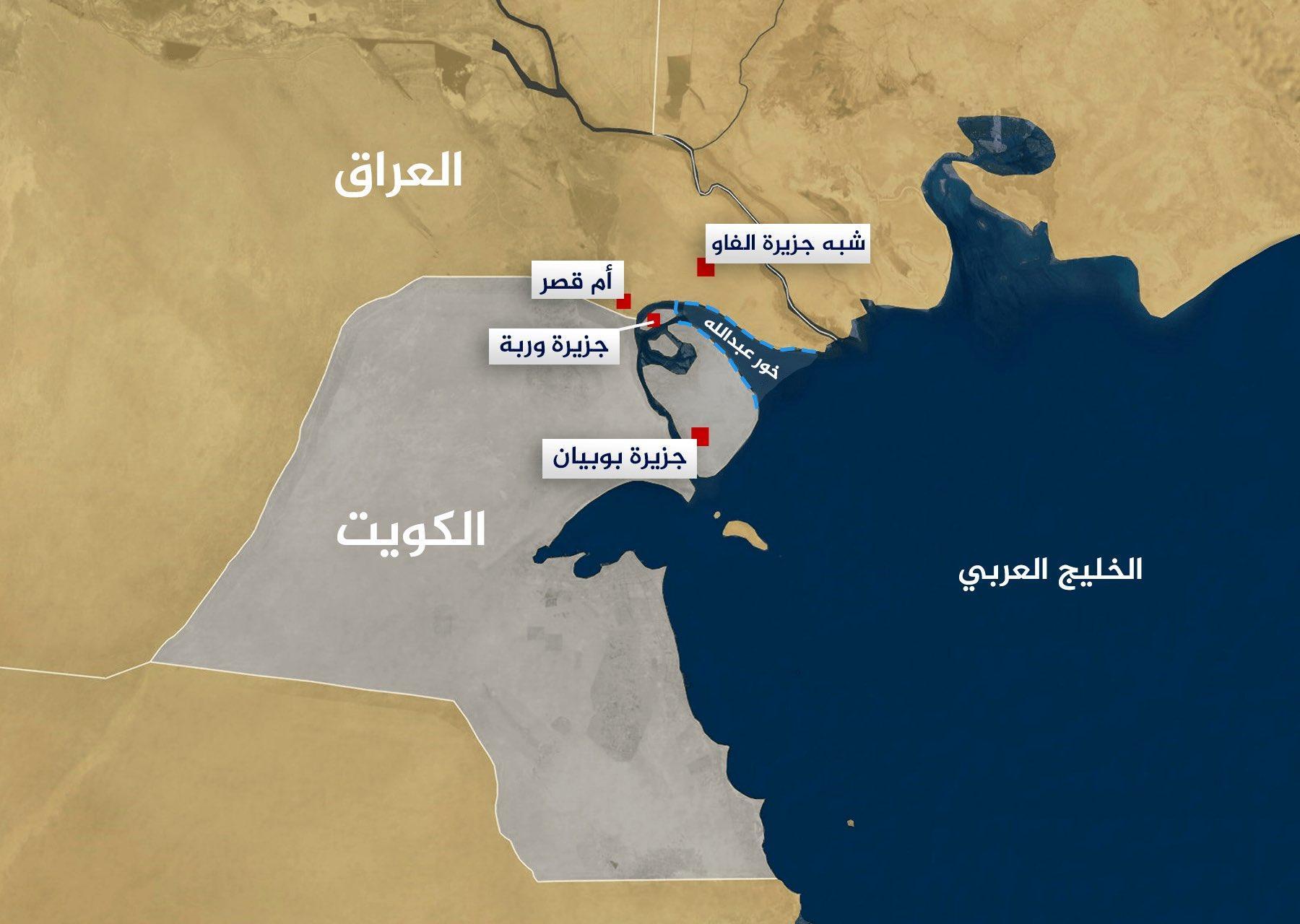
Image source: Al-Jarida Kuwaiti newspaper. The image depicts the location of Khawr Abdullah, a point of dispute between Kuwait and Iraq.
Despite the improved relations between the two countries since 2003, the maritime border issue, foremost among them Khawr Abdullah, has remained a sensitive file in the relationship between the two neighbors.
Khawr Abdullah is located in the northern Arabian Gulf. It is a narrow waterway that extends between the Iraqi Al-Faw Peninsula to the northwest and the Kuwaiti islands of Bubiyan and Warbah to the southeast. Its length is about 40 kilometers, and it is considered Iraq's main maritime outlet to international waters in the Gulf. As for Kuwait, it represents the main transit route for ships heading to the Mubarak Al-Kabeer Port, which Kuwait began constructing in 2011.
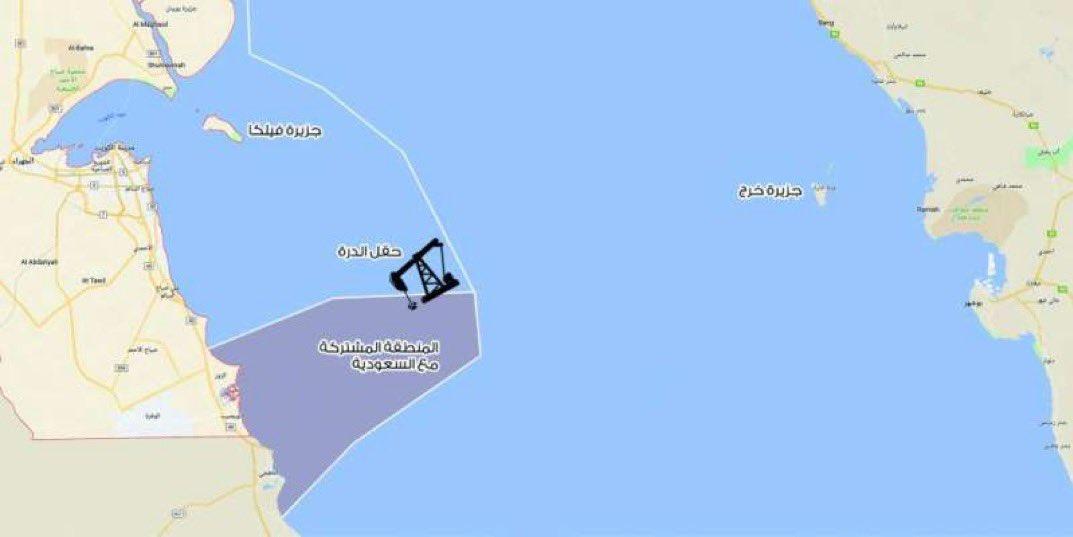
Location of the Durra oil field, with allegations that Iraq redrew its maritime borders. Image source: Al-Rai newspaper.
The sensitivity of this passage lies in the fact that it is a vital artery for navigation and trade for both countries, which makes any legal or political move regarding its border demarcation subject to close scrutiny from both sides.
Coinciding with the escalating tension between the two countries over this vital area, a coordinated digital campaign emerged involving Kuwaiti and other Gulf accounts—Saudi and Emirati—that attacked Iraq with the hashtag #العراق_لازم_يتأدب (Iraq must be taught a lesson) alongside the two hashtags #خور_عبدالله_الكويتي (Kuwaiti Khawr Abdullah) and #حقل_الدره (Al-Durra oil field).
Iraqi accounts promote maps, and Kuwaiti accounts launch a campaign
Before Kuwait summoned the Chargé d'Affaires of the Iraqi Embassy and handed him a protest note regarding the maps deposited with the United Nations, several Iraqi accounts launched the hashtag #خور_عبدالله (Khawr Abdullah) to promote the step of submitting the maps.
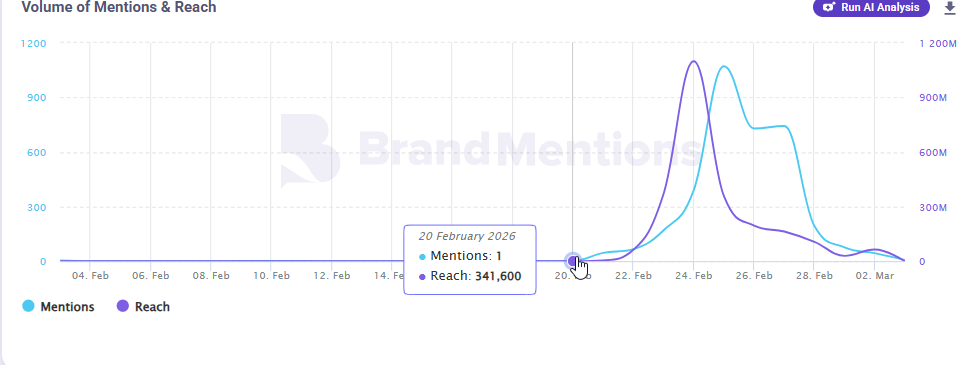
Graph showing the sudden spike in the number of posts about Khawr Abdullah and Durra field starting from February 20.
On the morning of February 21, an account belonging to MP Dr. Haider al-Salami posted about Iraq submitting maps related to Khawr Abdullah with the United Nations, and in another post, the account mocked a clip showing Kuwaiti army maneuvers on the Iraqi border.
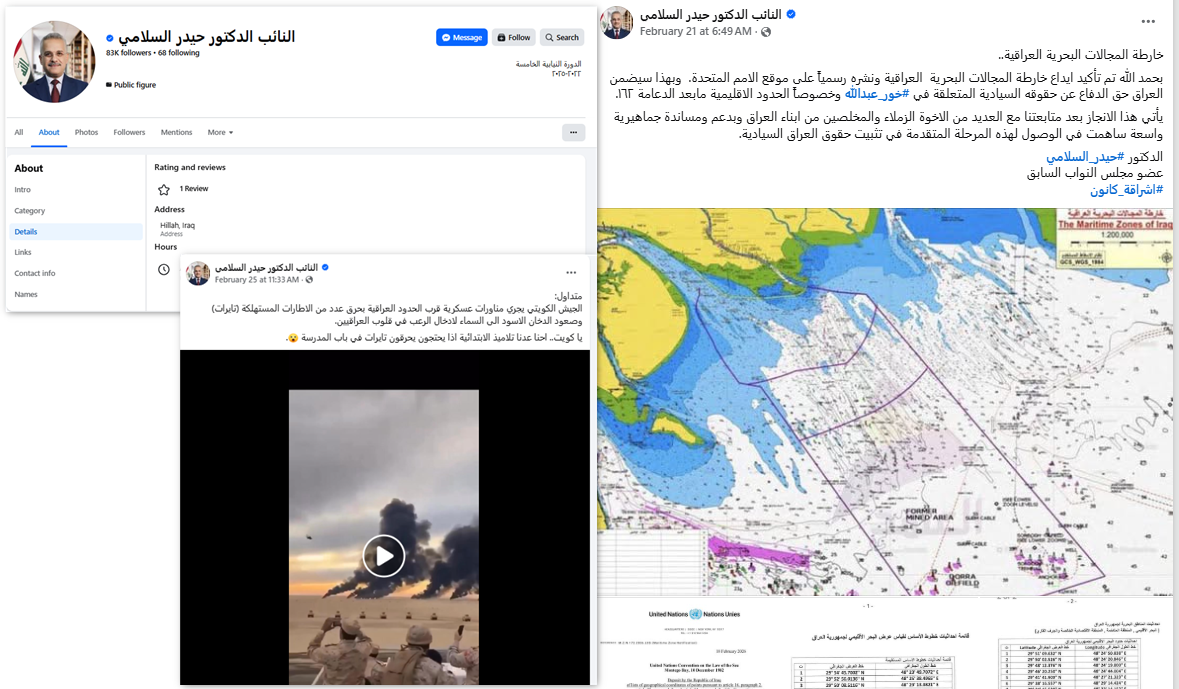
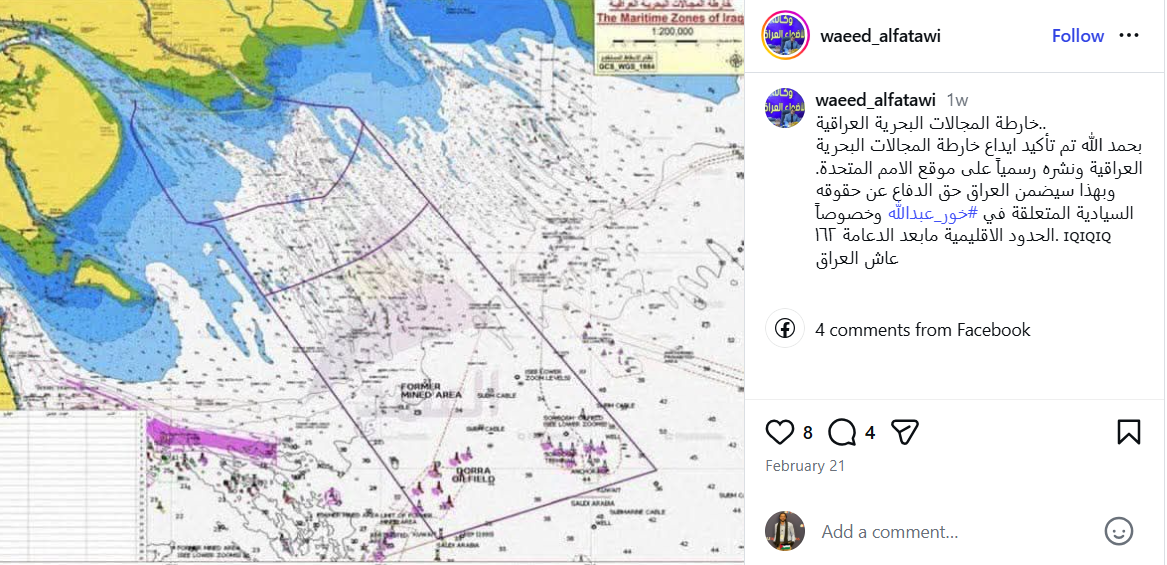
First image: A tweet containing a map of the Iraqi maritime domain presented to the United Nations, which includes a part of Khawr Abdullah Bay. Second image: A tweet from an Iraqi MP mocking Kuwaiti military drills and threatening them.
Haidar Mohammed Habib Al-Salami, an Iraqi politician from Babil Governorate, was a member of the Iraqi Council of Representatives during its fifth term (2022-2025). He is affiliated with the "Ishraqat Kanoon" political current and previously led its associated parliamentary bloc, "Ana Al-Iraq."
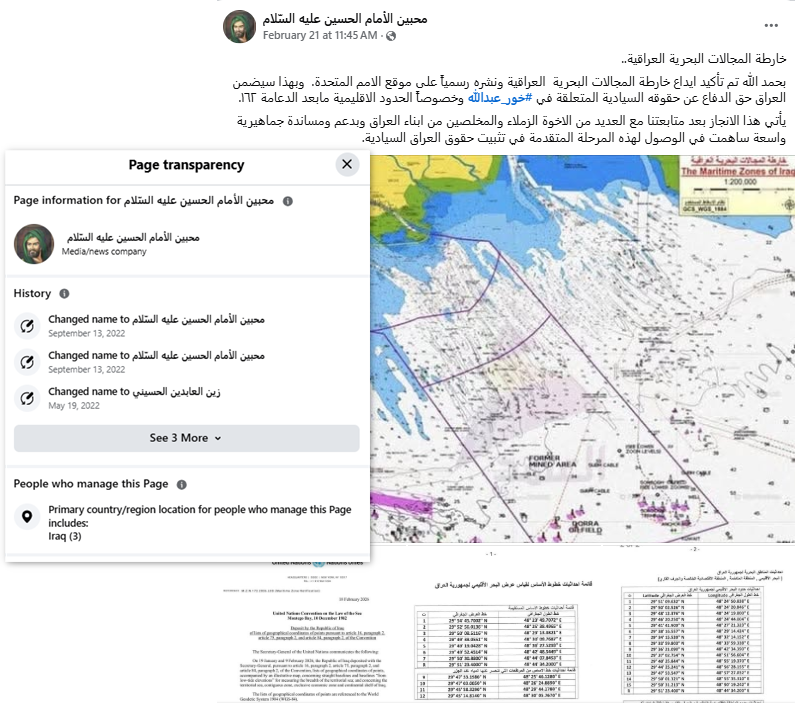
The Iraqi maritime domain map submitted to the United Nations, which includes a part of Khawr Abdullah Bay, with posts drafted to match what MP Haider al-Salami published.
Following Haider al-Salami's post, several Iraqi accounts republished the exact same text with an identical phrasing. A page called "Lovers of Imam Hussein (PBUH)" published an identical post, and the transparency feature showed that the page was created in 2015, changed its name five times, and is managed by three people from Iraq.
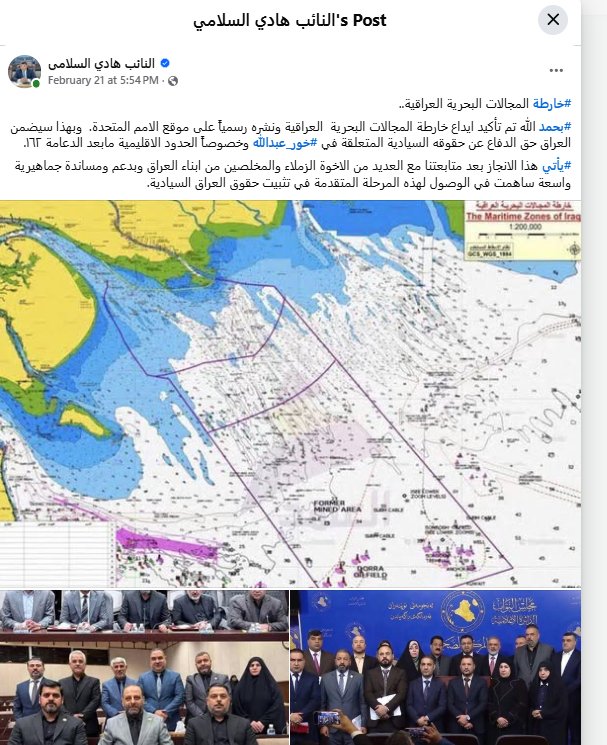
The account bearing the name of MP Hadi Al-Salami also published the same post. Hadi Hassan Maraihej Humi Al-Salami is an Iraqi politician from Najaf Governorate, born in 1972. He won the parliamentary elections for the fifth session (2022-2025) and served as a member of the Integrity Committee.
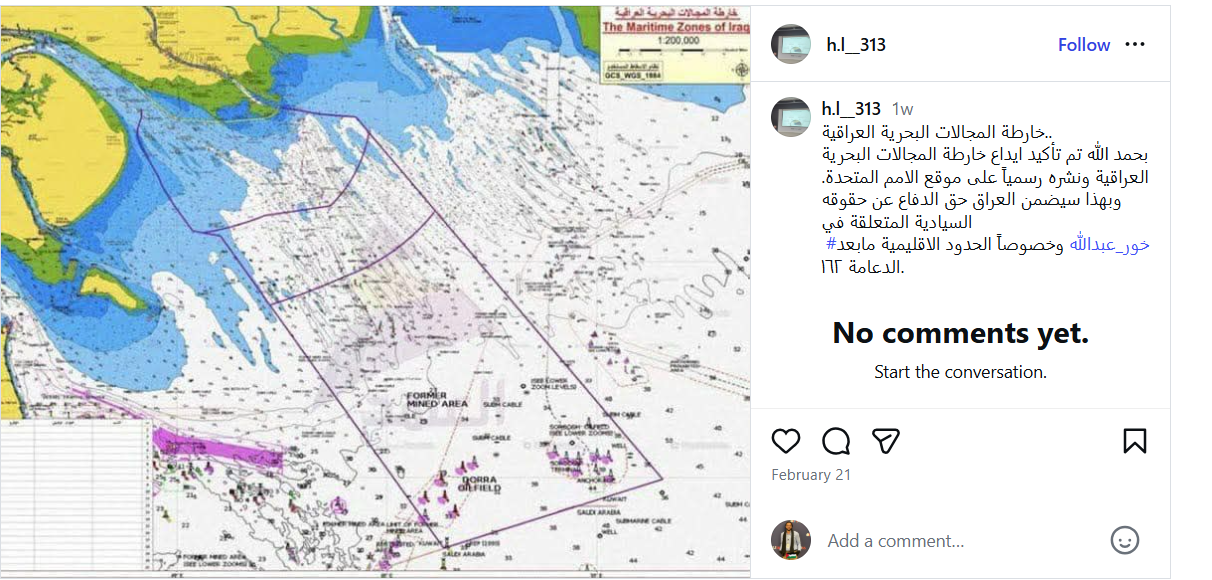
The organized recycling of political content or coordinated patterns of activity are often indicated by the repetition of identical texts and wordings across numerous accounts within a short timeframe. This was evident when Iraqi political figures' Instagram accounts reposted Haidar Al-Salami's message using the same, essentially unedited, phrasing.
Kuwaiti Accounts Mobilize
In Kuwait, the hashtag #خور_عبدالله_كويتي (Khawr Abdullah is Kuwaiti) appeared via an account called "Saddah Al-Otaibi," an account that reactivated the hashtag, and included content with negative descriptions of Iraq and criticism of the Iraqi action.
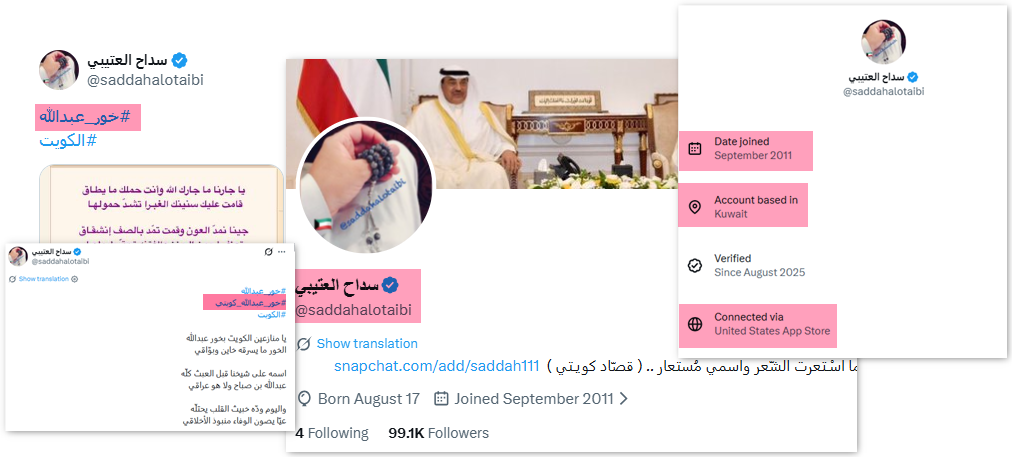
The Sdah Al-Otaibi account reactivated the hashtag #خور_عبدالله_كويتي (Khawr Abdullah is Kuwaiti) and posted content criticizing Iraq's move, while the account appears to be operating from the United States.
On February 22, the posts escalated to a higher level via the hashtag #العراق_لازم_يتأدب (Iraq must be taught a lesson), which Kuwaiti accounts used in posts carrying sharp anti-Iraq rhetoric.
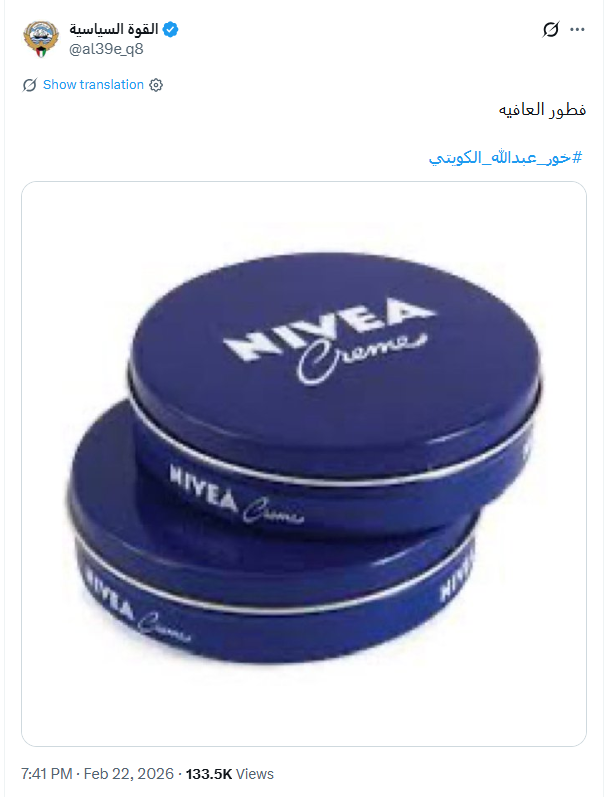
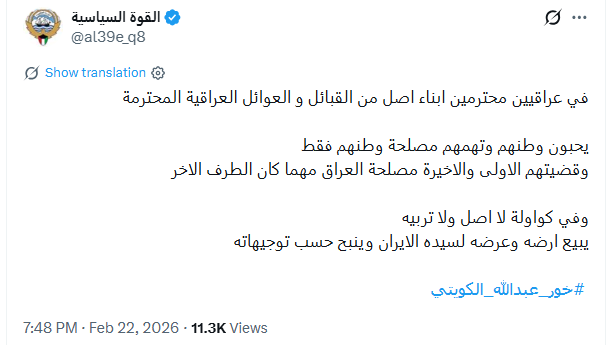
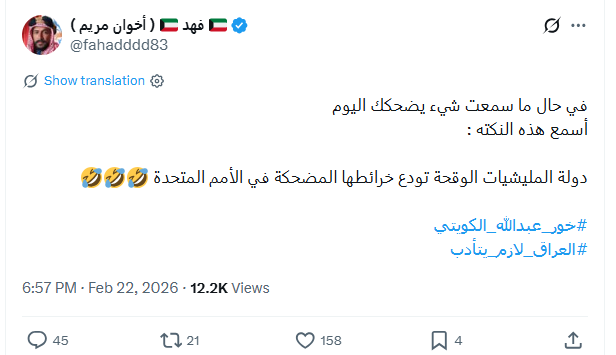
The rhetoric escalated through the hashtag #العراق_لازم_يتأدب (Iraq must be taught a lesson), which was used by Kuwaiti accounts in harsh posts against Iraq, including describing some Iraqis as "Kawawla (a derogatory term) with no origin or manners."
General Indicators
Activity related to the hashtags began on February 21, coinciding with the announcement by the Kuwaiti Ministry of Foreign Affairs that it had summoned the Chargé d'Affaires of the Iraqi embassy, and peaked on February 25, according to monitoring data.
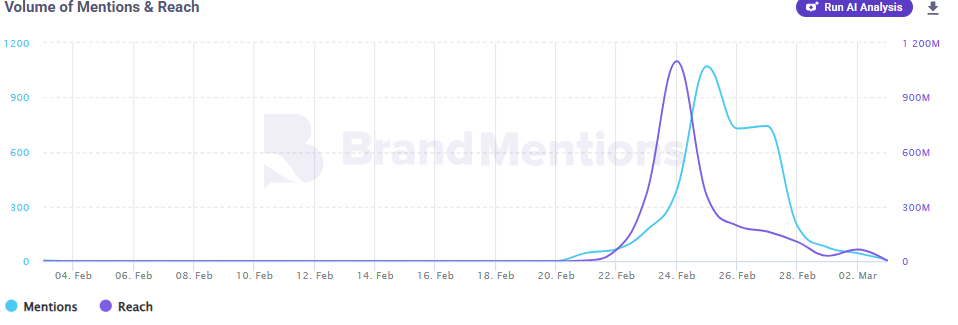
A chart showing the escalation of hashtag-related activity since February 21, peaking on February 25.
An analysis of the daily number of posts compared to the total reach shows that the content reach curve does not match the curve of the number of posts over the days. During some periods, the reach significantly increased without a parallel increase in the number of posts, which is an indicator used in digital campaign analysis to detect the possibility of non-organic amplification of some content.

The total number of posts associated with the hashtags reached about 3,500 posts, achieving an estimated reach of nearly 2.5 billion impressions and about 48 million interactions.
The total number of posts associated with the monitored hashtags reached about 3,500 posts, collectively achieving an estimated reach of nearly 2.5 billion impressions, in addition to about 48 million interactions. These figures appear mathematically disproportionate to the volume of content published over a short period, which strengthens the hypothesis of paid promotion or boosting for some posts, without conclusively determining the nature or source of this boosting.
Platform Distribution
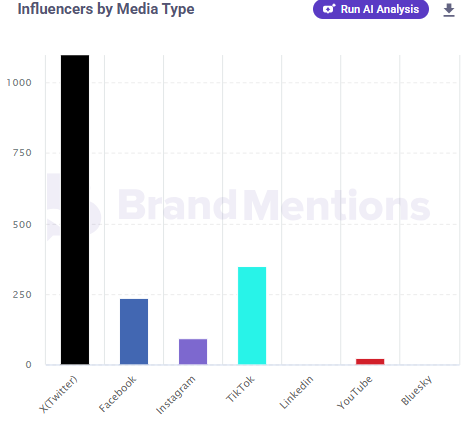
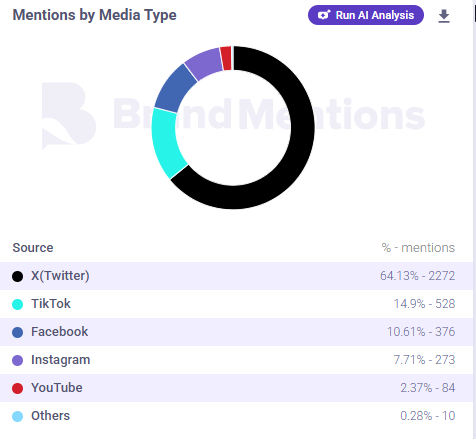
The images illustrate the distribution of posts across various social media platforms.
X accounted for the largest percentage of total posts associated with the hashtags, with about 64% of the content published through it. TikTok came in second with a percentage of nearly 15%, followed by Facebook with about 11%, while the remaining percentage was distributed among other platforms.
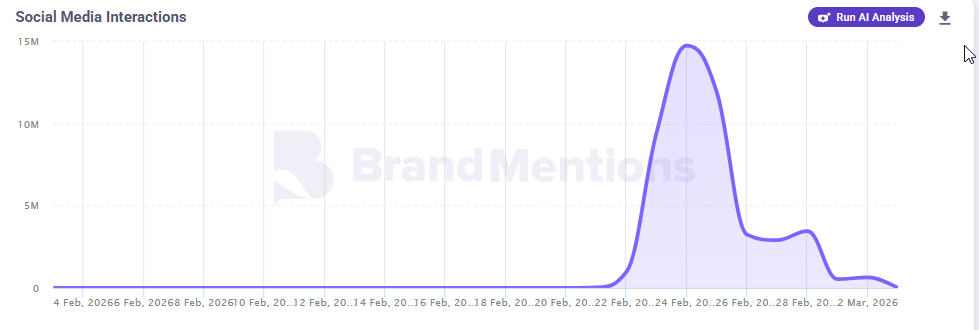
A chart illustrating the rise and fall of engagement with posts during the digital campaign.
This distribution shows that X was the primary platform where the discussion and escalation related to the hashtags took place throughout the monitoring period.
Most Frequently Used Hashtags
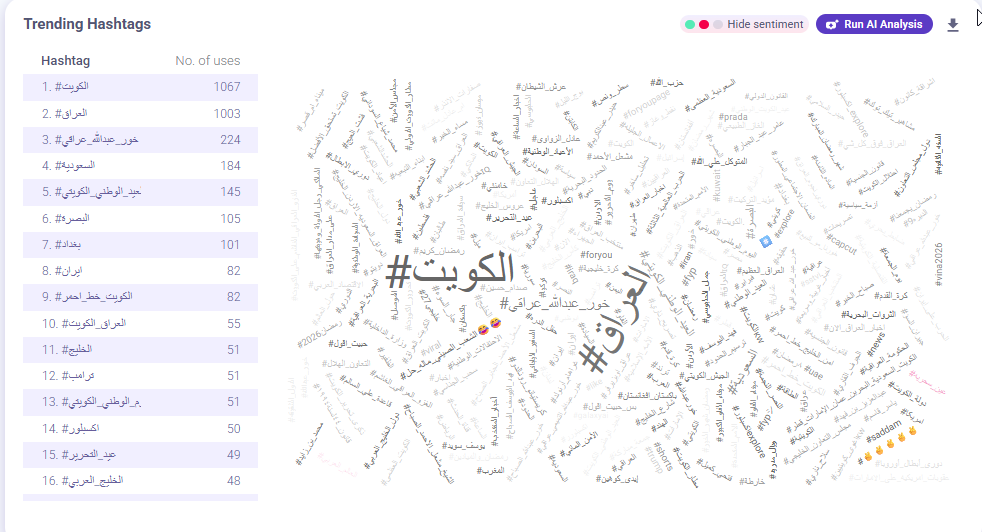
Word cloud showing the most trending hashtags.
The list of trending hashtags showed a clear presence of discourse related to the tension between Iraq and Kuwait. Alongside the hashtag #خور_عبدالله_كويتي (Khawr Abdullah is Kuwaiti), hashtags such as #الكويت_خط_احمر (Kuwait is a red line) and #العراق_الكويت (Iraq Kuwait) stood out, countered by the opposing hashtag #خور_عبدالله_عراقي (Khawr Abdullah is Iraqi).
This polarization was also reflected in the cloud of most frequent words, where vocabulary focused on sovereignty, borders, navigation, and maritime rights, reflecting the political and legal nature of the ongoing discussion.
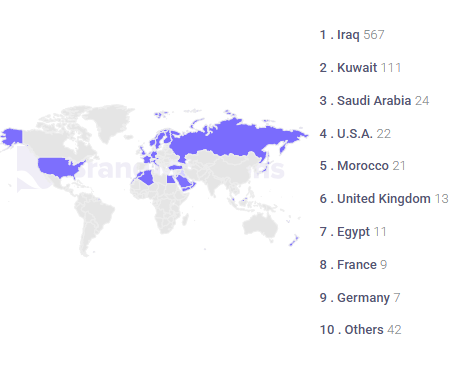
Geographical distribution of posts related to the digital campaign.
Geographic Distribution
At the level of the geographic locations of the participating accounts, Iraq and Kuwait topped the list of the most active countries in publishing, followed by Saudi Arabia in third place, then the United States, Morocco, the United Kingdom, and Egypt.
This distribution indicates that the interaction was not limited to the two countries directly involved in the dispute, but extended to a wider regional and international scope, which is consistent with the nature of issues related to maritime sovereignty and navigation in the Arabian Gulf.
Inauthentic Iraqi and Kuwaiti Accounts and Their Impact on the Digital Clash
The following accounts topped the list of the most interactive accounts during the monitoring period, according to the Brand Mention tool analysis:
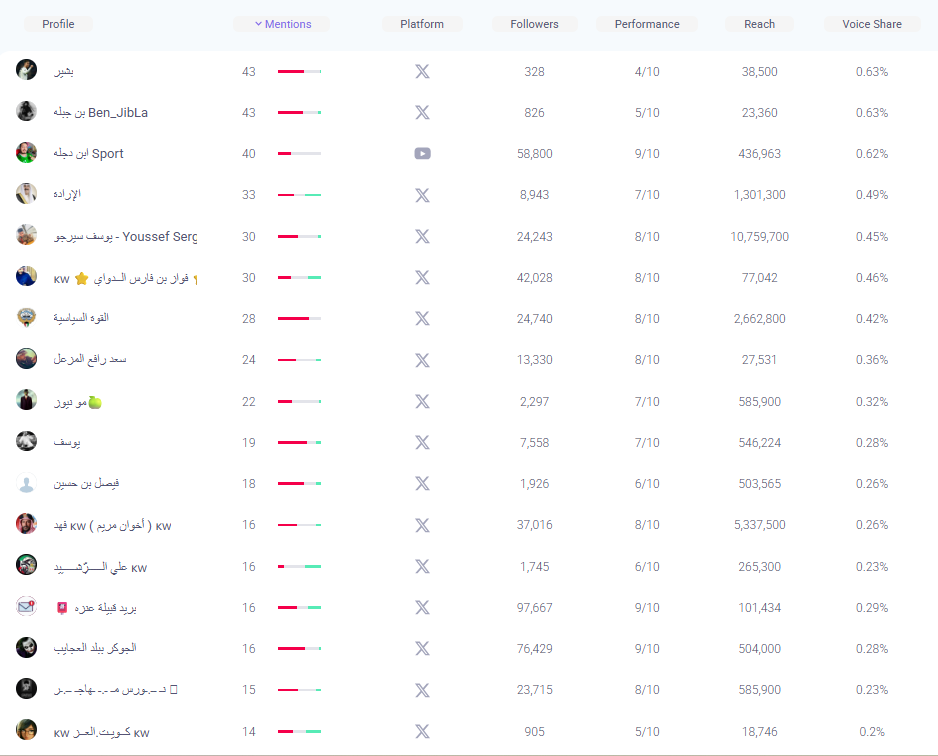
List of Most Active Accounts in the Digital Campaign:
- Basheer (@basheeriraqi20)
Published 43 tweets including the hashtag #خور_عبدالله. (Khawr Abdullah) Although the transparency feature showed the account as Iraqi, it attacked Iraq in a large number of its tweets.
The account's creation date goes back to 2021, it does not contain a profile picture, and the username appears to be inauthentic, which reinforces the hypothesis that it is a fake account.
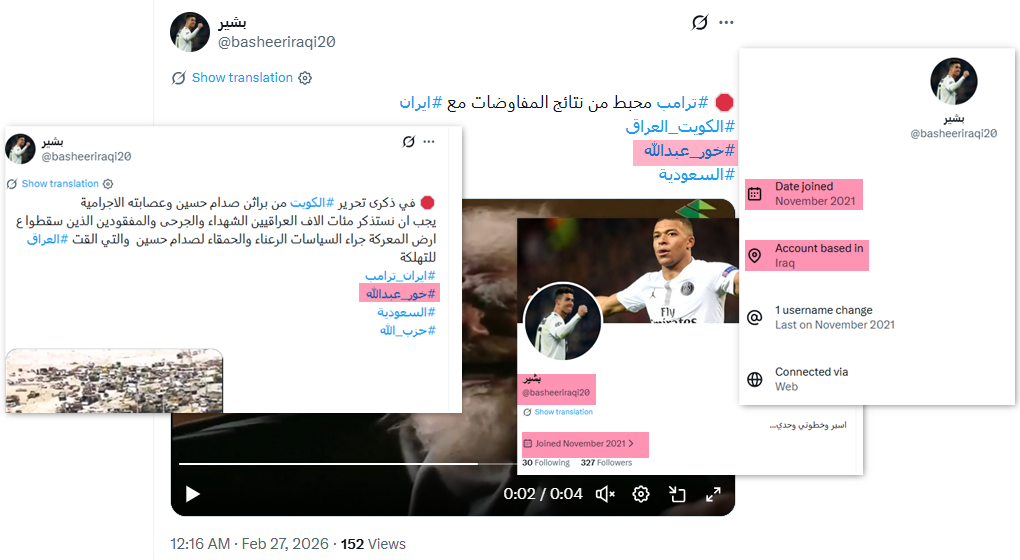
A tweet including the hashtag “Khawr Abdullah”; although the transparency feature shows the account is Iraqi, it has attacked Iraq in a large number of its tweets.
- Ben JibLa (@Ben_JibLa)
Published 43 tweets associated with the hashtag #خور_عبدالله_الكويتي (Kuwaiti Khawr Abdullah), focusing on the political promotion of Kuwait and directing accusations at Iraq of encroaching on its sovereignty.
The account is Kuwaiti and active from Kuwait, although the specified geographical location indicates Switzerland. It does not use a real profile picture, which confirms the possibility of it being a fake account.
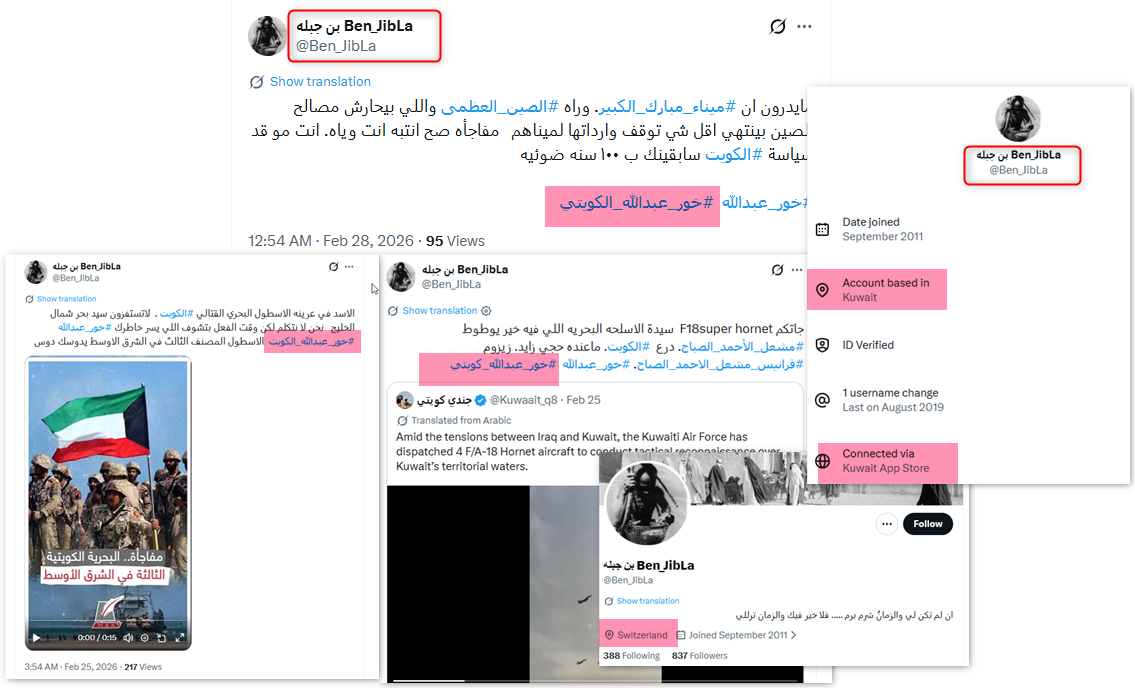
A screenshot of Ben_JibLa's account showing the publication of 43 tweets related to the hashtag “Khawr Abdullah”, which focused on the political promotion of Kuwait and the accusation that Iraq is infringing on its sovereignty.
- الإرادة (@Ordu1325962)
Posted 33 tweets, all related to the political promotion of Kuwait via the hashtag #خور_عبدالله_كويتي (Khawr Abdullah is Kuwaiti).
The account was created in 2023, is active from Turkey, and does not use a real name or picture, instead relying on random letters and numbers, which makes it a fake account dedicated to political promotion.
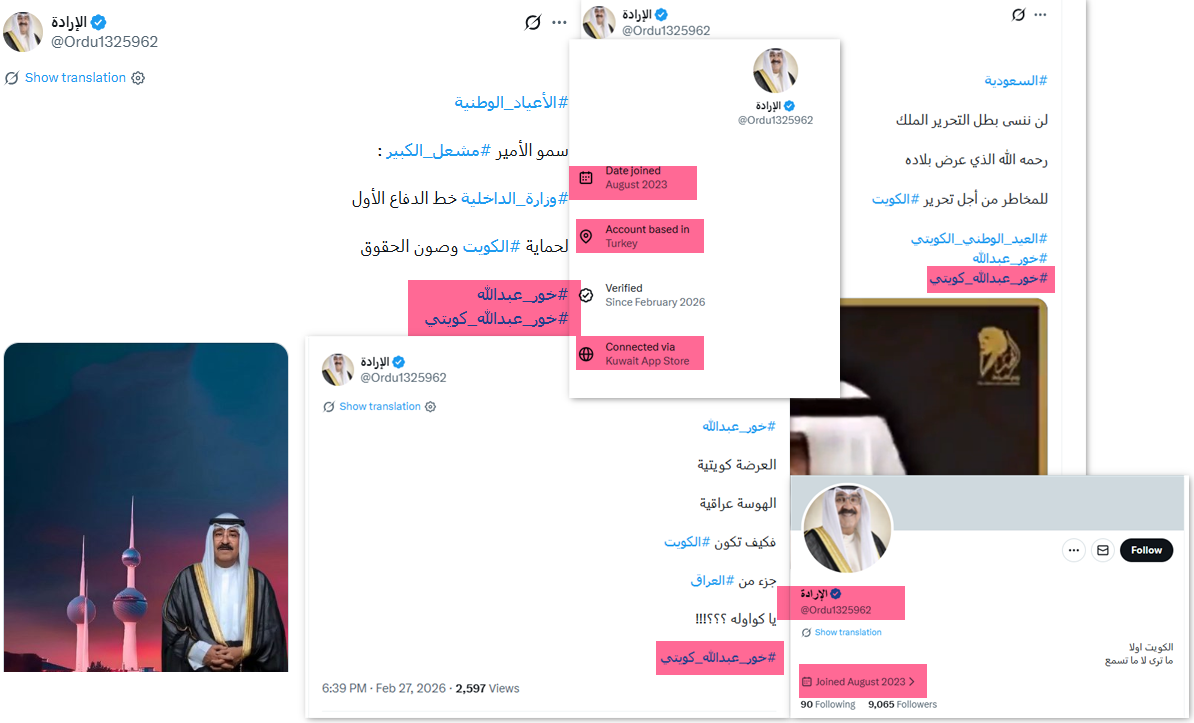
A screenshot showing that the Al-Irada account (@Ordu1325962) published 33 tweets, all of which politically promote Kuwait via the hashtag “Khawr Abdullah is Kuwaiti”.
- Fawaz bin Fares Al-Dawwai (@FawazAldawai)
He posted 30 tweets related to the hashtag #خور_عبدالله_كويتي (Khawr Abdullah is Kuwaiti), all of which focused on the political promotion of Kuwait.
The account is Kuwaiti and operates from Kuwait, but the connection to X was made from the United States, and it does not use a personal photo or a real name.
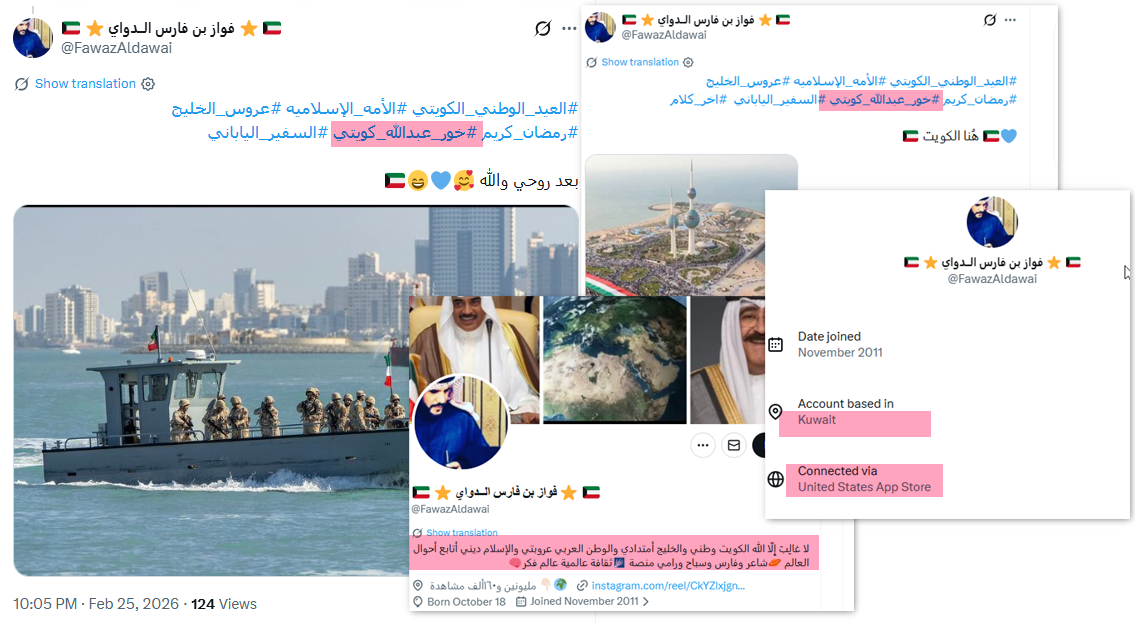
Screenshots show that Fawaz bin Fares Al-Dawwai (@FawazAldawai) published 30 tweets associated with the hashtag “Khawr Abdullah is Kuwaiti”.
- Political Power (@al39e_q8)
Published 28 tweets linked to the hashtag #خور_عبدالله_كويتي (Khawr Abdullah is Kuwaiti), which included inflammatory rhetoric and insults against Iraq and the Iraqi people. The account is a non-personal Kuwaiti account, created in 2017, and the username consists of random letters and numbers. It shows the connection to X is from the United States.
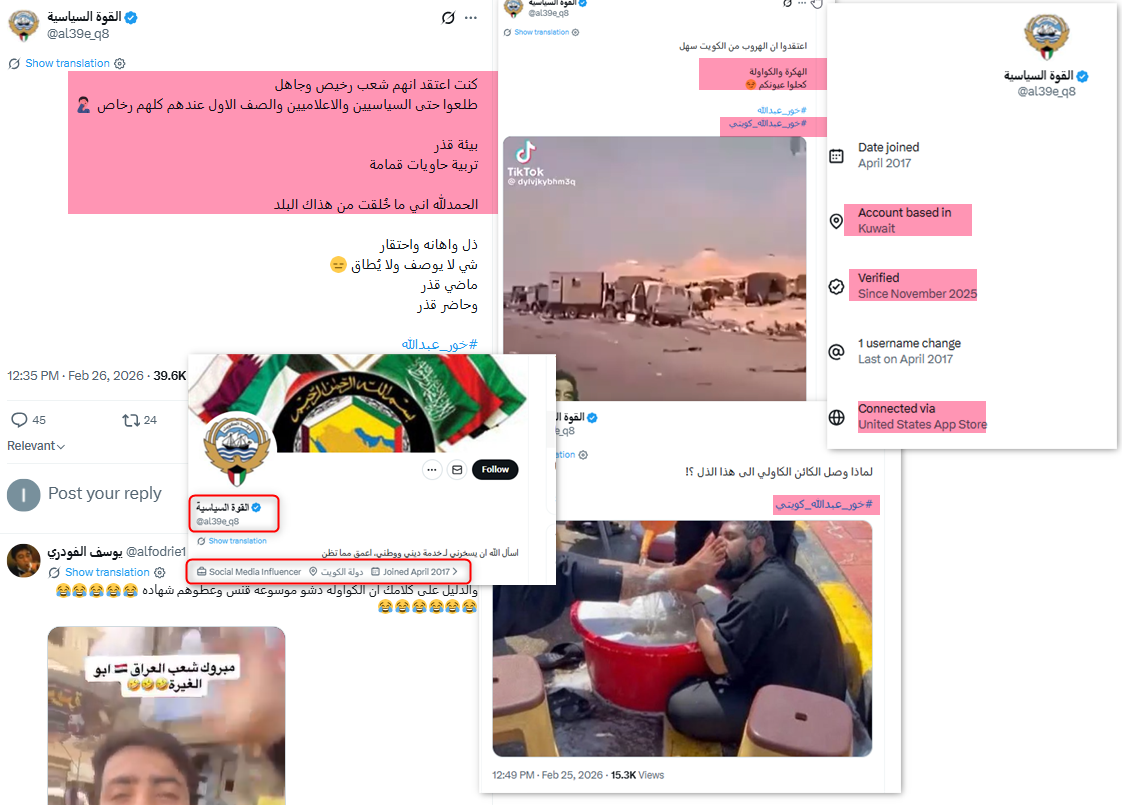
Screenshot showing that the Political Force account (@al39e_q8) published 28 tweets related to the hashtag “Khawr Abdullah is Kuwaiti”.
- Fahad (Maryam's Brothers) (@fahadddd83)
Used the hashtag #العراق_لازم_يتأدب (Iraq must be taught a lesson), and targeted Iraq with rhetoric describing it as a "state of insolent militias."
The account uses the Kuwait flag, was created in 2021, does not use a real picture or name, and the geographical location points to West Asia.
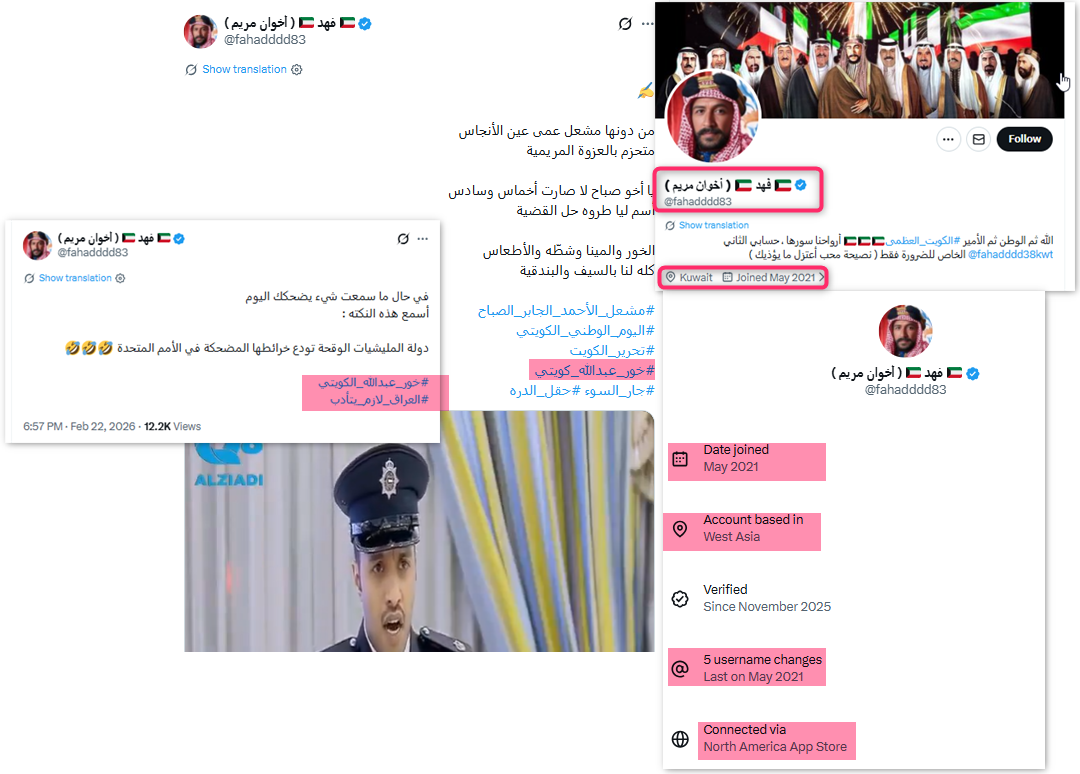
A screenshot showing the account of Fahad (Ikhwan Maryam) (@fahadddd83) using the hashtag “Iraq must be taught a lesson”.
- Youssef Sergo (@Y78_38)
Posted 30 tweets related to the hashtag #خور_عبدالله (Khawr Abdullah), most of which included inflammatory rhetoric against Kuwait but supported Iraq.
The account was created in 2020, is active from West Asia, and has changed its name 49 times, using random letters and numbers, which increases the likelihood of it being a fake or non-genuine account.
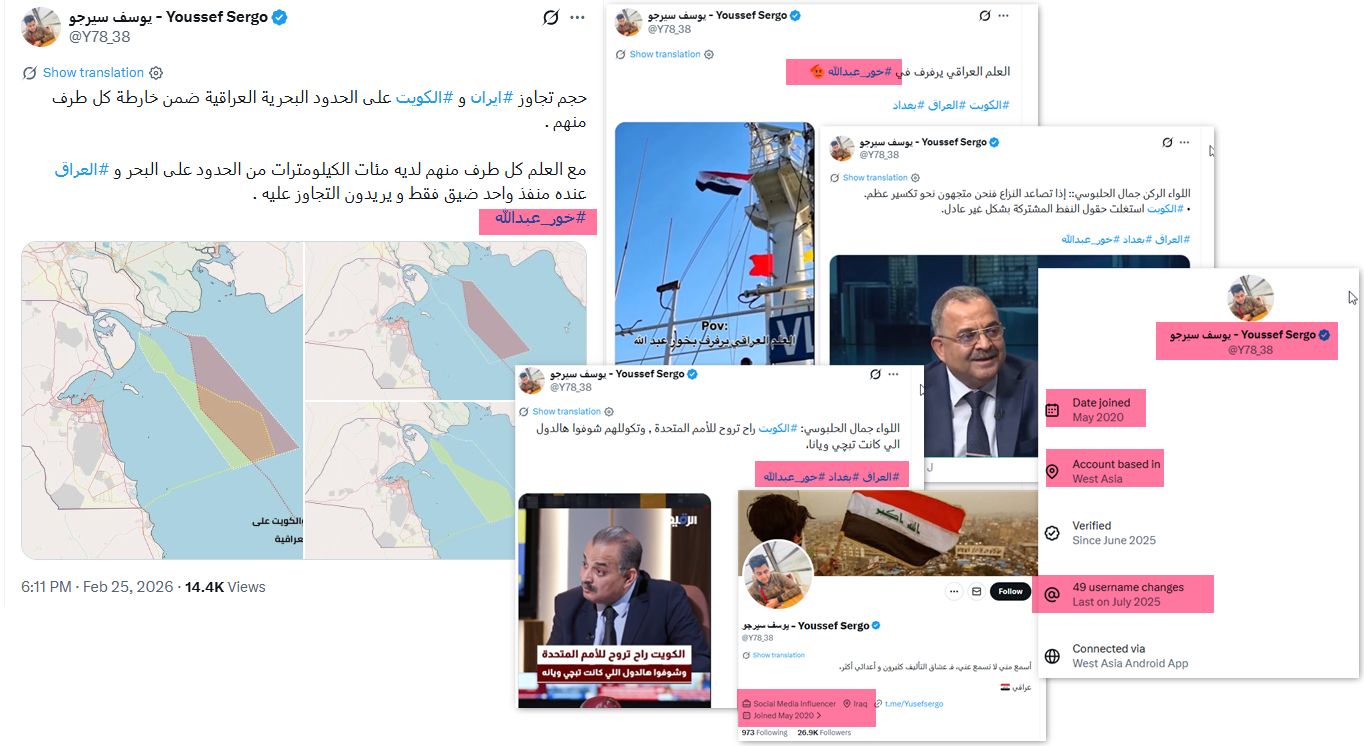
A screenshot showing Youssef Sergo's account (@Y78_38) publishing 30 tweets associated with the hashtag “Khawr Abdullah”.
History of the Khawr Abdullah Dispute
The debate surrounding the maritime borders between Kuwait and Iraq dates back to the early twentieth century, when Kuwait was under British protection following the 1899 treaty. In 1913, Britain and the Ottoman Empire reached the Anglo-Ottoman Convention, which included preliminary lines for border demarcation, but this agreement did not enter into force due to the outbreak of World War I.
In 1922, the Uqair Protocol established a new framework for the land borders, but it did not resolve the issues related to the maritime passage.
In 1932, Iraqi Prime Minister Nuri al-Said defined the borders with Kuwait in official correspondence with the British High Commissioner, and in 1963 Iraq officially recognized these borders, making this the legal basis upon which the border relations between the two countries were later founded. Nevertheless, the dispute over Khawr Abdullah remained due to its significant economic importance for both countries.
During the era of former Iraqi President Saddam Hussein, Baghdad considered its maritime facade on the Gulf to be too narrow (about 13 kilometers), while Kuwait considered this to restrict its adequate maritime access, pushing it to demand redemarcation. At one stage, Saddam Hussein demanded the lease of the Kuwaiti islands of Bubiyan and Warbah, which Kuwait categorically refused.
On August 2, 1990, Iraqi forces invaded Kuwait, and Saddam Hussein officially announced its annexation to Iraq. After about 20 weeks of international mobilization, an international coalition led by the United States and authorized by the United Nations launched a military campaign that ended with the liberation of Kuwait on February 28, 1991. This invasion left profound repercussions on the relations between the two countries and led to the redrawing of borders under international supervision.
The UN Security Council then issued a series of binding resolutions that formed the legal framework for the borders between the two countries: Resolution 687 (1991): obliged Iraq to respect the internationally recognized borders with Kuwait, Resolution 773 (1992): established a UN commission for border demarcation, and Resolution 833 (1993): was issued under Chapter VII of the UN Charter, making it legally binding for all parties, and the Khawr Abdullah area was considered a common area between the two countries.
Kuwait affirmed that Resolution 833 definitively settled the issue of maritime borders, including the regulation of navigation in Khawr Abdullah as a common waterway between the two countries. As for Iraq, which was then going through a period of extreme weakness after the Gulf War and international sanctions, it accepted the resolution in principle in compliance with Security Council resolutions, but it expressed reservations about some points related to the maritime borders inside the Khawr. Since then, these reservations have remained present in the Iraqi position and have been inherited by successive governments, so the issue of Khawr Abdullah remains one of the most sensitive border files between Baghdad and Kuwait.

Other Articles