Prepared by: Sherif Murad
Arabi Facts Hub
is a nonprofit organization dedicated to research mis/disinformation in the Arabic content on the Internet and provide innovative solutions to detect and identify it.
In times of crises and wars, the course of events is not shaped by facts alone, but also by the way news is narrated, the headlines that are repeated, and the angles chosen by different platforms to interpret what is happening. This is why this series of data-driven analytical reports was produced, a collaboration between Arabi Facts Hub and the independent research initiative "Anmat" which aims to analyze the Arab media coverage of the war related to Iran, and monitor how the competing narratives around it were shaped across media and digital platforms.
The series includes six journalistic stories built on a database prepared and analyzed by the Anmat team, based on the content of five widely circulated and influential Arabic-speaking digital platforms in the public sphere: BBC Arabic, Russia Today (RT Arabic), Al Jazeera, Sky News Arabia, and Al Arabiya. The work involved collecting published materials during the three days preceding the American-Israeli strike, and then the first seven days of the outbreak of the war, during the period from February 28 to March 6, using open-source Python libraries.
The analysis relied on the Association Rule Mining (ARM) methodology to study headlines and body texts at several levels, which included monitoring the most frequently repeated words, analyzing and measuring the prevalence of repeated linguistic structures, and then extracting the dominant patterns with statistical indicators clarifying the strength and presence of each pattern, while taking into account the differences in publication volume among the various platforms. The results were also read comprehensively, at the level of each platform, as well as according to the temporal shifts in coverage.
Based on this data, the editorial team at the "Arab Verification Community" worked to review the results and read them journalistically, and then build reports that do not merely display numbers, but attempt to understand what lies behind them: How did the platforms differ in covering the event? What are the most prominent narratives? And how were political positions reflected in the language and headlines?
These reports do not claim to offer final judgments, but seek to provide a deeper reading of the media scene during the first week of the war, by combining data analysis with editorial insight, to understand how news is made, and how its meaning is reshaped in moments of conflict.
In this Article...
We address the way a number of Arab platforms dealt with the news of the assassination of the Iranian Supreme Leader Ali Khamenei, and how some coverage went beyond the event itself to broader questions concerning the future of the Iranian regime, succession, and the possibilities of collapse or political restructuring.
This report relied on reading a sample of news and headlines related to Khamenei within the project's database, then manually coding the headlines according to the dominant framework of each article. After building the initial editorial reading, it was tested in light of the Association Rule Mining files specific to each platform, particularly the headline files for Sky News Arabia, Al Arabiya, and RT Arabic, and the body text file for BBC Arabic. These rules are not used here as a substitute for journalistic reading, but as a verification tool for the repetition of linguistic patterns that appeared in the sample, with reference to the original news and its editorial context.
The Report:
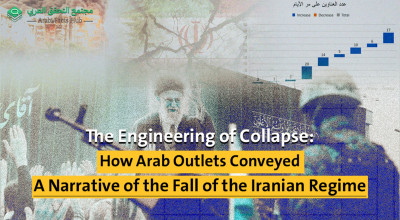
In the wake of Khamenei's assassination, various Arab media outlets viewed the occurrence not simply as an individual's passing, but as a defining turning point for the Iranian regime's survival. They quickly jumped from the news of the assassination to questions of succession, collapse, surrender, and the possibilities of the post-regime era.
A portion of the Arab media quickly moved past the initial details of the Supreme Leader's assassination. They focused instead on the broader question of what comes next. In many reports, the event was not framed as a declaration of war or a violation of international law. It was also not seen as just the dramatic end of a leader. Instead, it was presented as the start of a new phase for Iran. This included discussions on vague succession plans, potential surrender, and scenarios of a collapsing or restructured regime.
In contrast, other platforms chose a more cautious or complex approach, making the Arab coverage less like a record of war news, and more like an arena for constructing a vision of Iran after the end of the regime.
Assassination News or the Regime's Future?
In traditional war coverage, an event of this type is supposed to occupy its natural place: the assassination of a senior leader, followed by monitoring its immediate military and political consequences. However, a portion of Arab headlines quickly jumped from the assassination itself to what came after, as if the man was no longer the story, but the vacuum he left behind, or the regime that might not survive him.
This is evident in headlines such as: "The Third Leader, Eyes on the Candidates for Khamenei's Succession", "The Choice of Khamenei's Successor is Approaching, and Washington Prefers Him as a Friend", and " Iran After Khamenei: Who Will Sign the Surrender ".
The narrative surrounding Khamenei's assassination shifted away from being framed as a regional political struggle or a formal declaration of war by Israel and the United States against Iran. It evolved instead into a gateway for asking: With Khamenei gone, who is positioned to assume power, under what circumstances will they lead, and can the state maintain its structural integrity?
This transition is not a small linguistic detail. It is a shift of the center of gravity from the military event to political imagination. Instead of the coverage being preoccupied with whether Khamenei's assassination would lead to escalation, an Iranian response, a direct change on the ground, or even the legal consequences of the operation, some headlines began treating it as immediately opening another file: the file of the post-regime era, or at least the era after the head of the regime. This is an important distinction; because the language did not merely describe what happened, but anticipated what might happen next.
In this context, headlines like "Khamenei Faces the Biggest Challenge Since the Iranian Revolution" or "Khamenei on the Path of Nasrallah" do not appear as mere dramatic descriptions, but construct an image of the man as a sign of a greater moment of breakdown, not just a leader in the heart of a battle.
While the first headline suggests the regime is facing an "existential test," the second draws on historical parallels to frame the current situation. Together, they recast the assassination as more than just a singular occurrence; it becomes a catalyst for broader narratives, such as the potential downfall of a political system, the abrupt conclusion of a conflict, or a turning point for the nation as a whole.
This tendency did not appear in a single headline, but in the repetition of similar linguistic patterns across a large number of news items. If Khamenei appeared in some materials as a leader or as part of the war machine, these headlines specifically reveal another trajectory: transforming him from a person into a historical comma.
Hence, the question is not: How did the platforms cover his assassination? But: How did they use this assassination to quickly open the door to Iran after Khamenei?
Visions of the Post-Khamenei Era: Assessing Platform Divergence
This leap to the "post-Khamenei era" varied significantly across media outlets. When the headlines are read side-by-side, it appears that each platform did not just cover the event, but re-imagined it according to its own logic.
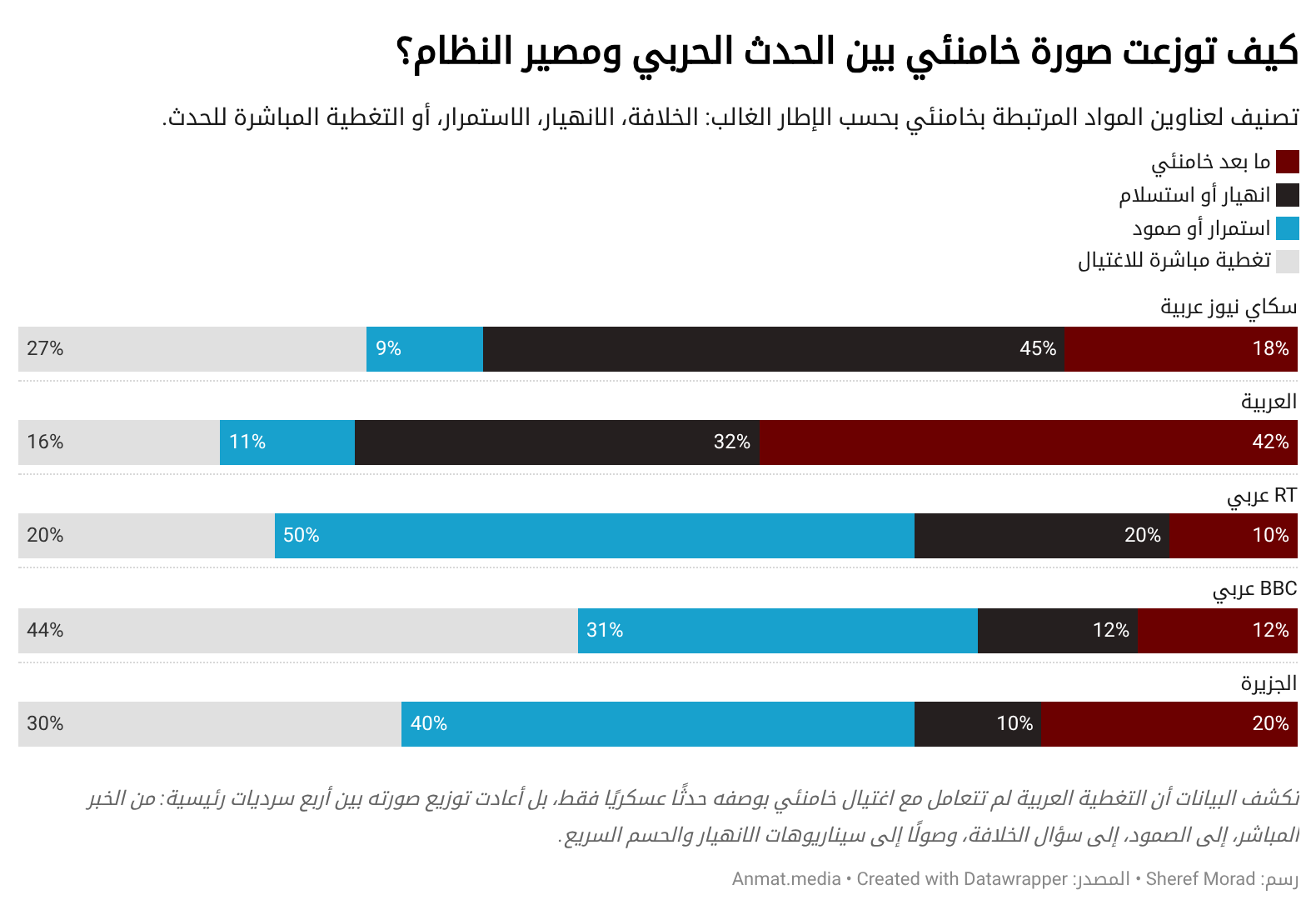
The distribution of coverage shows that Khamenei's assassination was not just news to be told, but a point of narrative division: between those who remained within the event and those who jumped to what came after, whether as a power transition or the beginning of a state collapse.
In the Gulf platforms, especially Al Arabiya and Sky News Arabia, the clearest tendency appeared to move beyond the man himself to the post-man era. Khamenei was no longer the center of the story here as much as he became a gateway for a quick passage to the question of succession or scenarios of state instability.
Headlines such as "The Third Leader" or "Peaceful Transition or Civil War?" are not greatly concerned with the circumstances of the assassination as much as they are concerned with the political vacuum it might open. In some cases, this logic expands to imagine a quicker end to the war itself, as in the question: "Iran After Khamenei: Who Will Sign the Surrender?". Here, Iran is not narrated merely as a state that suffered a blow, but as a regime that entered a moment of turmoil that might redefine its entirety.
However, this approach is not entirely uniform. Al Arabiya appeared more preoccupied with constructing the scene of the "post-man era", by intensifying references to the succession and the fate of power, while Sky News Arabia tended to broaden the scene towards an image of a confused country open to extreme possibilities, which might reach civil war. The difference here is that the first headline operates within the question "Who will succeed?", while the second leans toward a broader question: "What state will remain after this strike?".
Data from the association rules identified in platform headlines reinforces this interpretation. Within Sky News Arabia's output, a specific linguistic pattern emerged, connecting the terms "assassination," "successor," "refusal," and "Khamenei". This association exhibited absolute confidence and a significant "lift," indicating that the connection was a deliberate editorial trend rather than a random occurrence. While its frequency across the entire sample was focused, the pattern highlights a rigid conceptual link between reporting on the assassination and exploring the subsequent vacuum of leadership or the refusal to designate a new successor.
The "choice - Khamenei" association also surfaced in Al Arabiya’s headlines with a high degree of "lift" and total confidence. This recurring pattern supports the interpretation that the network prioritized the logistics of choosing a successor over the military specifics of the assassination itself.
In contrast, RT Arabic presented a different and more complex picture. Khamenei did not appear here merely as a fallen man, nor just the head of a collapsing regime, but as part of a state that still possesses cards of power, even as it is shaken.
Therefore, the coverage seems to combine two images: Capable Iran and Threatened Iran. Headlines such as "Iran's Most Important Cards of Power", or "Did Iran Repeat Gaddafi's Mistake?", or "Who Has the Authority to Announce the End of the War on Iran?" do not close the narrative to a single meaning. Instead, they present the reader with two parallel possibilities: the continuation of the state, and the possibility of a major breakdown. Here, Khamenei does not turn into a political corpse whose page is turned, but into part of a more complex scene: a strong regime, but one standing on the brink of what might be an existential test.
This fusion of strength and collapse makes RT less inclined to directly leap to the "post-Khamenei era" compared to Gulf aligned news platforms, and more inclined to depict a turbulent historical moment in which Iran remains an actor, even as it is pushed towards the brink of collapse. The portrayal of a "collapsing yet resilient regime" aligns more closely with this perspective than the depiction of a "system that has already reached its end."
In addition, the rules associated with Khamenei in RT's headlines do not lead to succession or surrender. Instead, the clearest association appears between “Khamenei” and “Tehran.” This pattern is weaker in confidence compared to Sky News and Al Arabiya, but it is indicative of its direction: Khamenei appears within the center of the state and the place of decision, not as a direct entry point to a power vacuum.
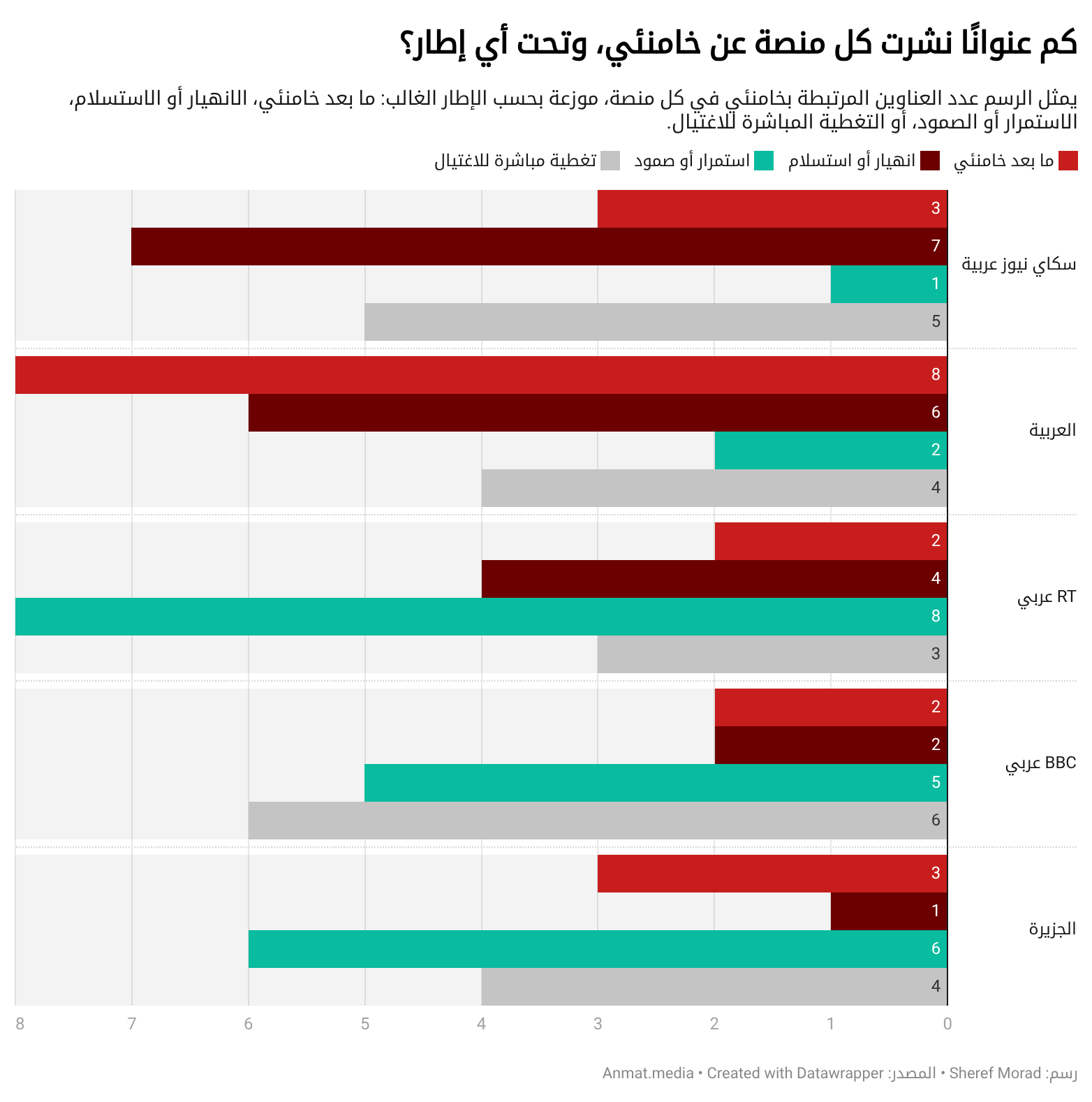
While the previous chart illustrates how each platform framed Khamenei's image, this chart shows the actual volume of coverage related to the late leader, revealing that the difference was not just in direction, but also in intensity of coverage within each platform.
As for BBC Arabic and Al Jazeera, they tended to have a more cautious approach, less quick to declare endings. In the BBC, the assassination appears as a pivotal event, but the narrative does not quickly conclude with a single outcome. Questions appear such as "Does overthrowing the Iranian regime necessarily lead to stability?" or "An exceptional moment Iran had been preparing for for years," which shifts the coverage from the certainty of collapse to a wider space of analysis and uncertainty. Here, Khamenei is not used only as a symbol of fall, but also as an entry point for a seasoned consideration of the regime's structure, and the ability of society and the state to absorb the blow or reshape the balances afterward.
The body texts of BBC Arabic also support this reading. The rules associated with Khamenei in the body texts did not show associations with narratives of succession, surrender, or collapse. Instead, they revolved around direct descriptions such as “Ali Khamenei,” “The Leader,” and “Iranian.” That is, Khamenei appears, in this layer of coverage, as a personality and a position within the event, not as an immediate abbreviation for the post-regime era.
Al Jazeera, in turn, seems less fascinated by the rapid-end narrative and more inclined to test the question of resilience. Headlines such as "The Mystery of the Fourth Alternative", or "Iran is Not Venezuela", or "Iran's Plan for Resilience" place the assassination in a context that does not deny the crisis but does not automatically assume the regime has entered a phase of final decline. Here, Iran appears as a state under intense pressure, but one that has not yet turned into an empty structure. This is a fundamental difference: the platform does not ignore the effect of Khamenei's absence, but neither does it treat it as an automatic abbreviation for the state's collapse.
What these differences reveal is not merely a difference in language, but a difference in political imagination. Some platforms imagined the assassination as a tool that would shorten the war and quickly open the door to the post-regime era. Others treated it as a moment of intensification of a deeper crisis, without asserting that the end had already been written. Between these two trends, Khamenei was no longer just a news personality; he turned into a screen onto which each platform projected its own vision of Iran: Is it a state that has entered the post-head phase? Is it a fracturing regime? Or is it an entity still capable of reproducing itself despite the blow?
What this coverage reveals is not limited to stylistic differences but reflects a deeper perception of the meaning of assassinating the head of the regime. Some headlines do not treat the event as a strike within a war but as a moment that is supposed to shorten the distance towards regime change.
In this sense, the talk of succession, surrender, civil war, and post-Khamenei was not just a dramatic extension but a reframing of the event within a pre-existing notion: that targeting the peak might be enough to push the state into a phase of rapid collapse.
At this specific point, some coverage does not seem to be monitoring possibilities as much as it seems to be moving within a ready-made political horizon: the head of the regime has fallen, therefore the state itself is supposed to be shaken, and perhaps crumble.
At this intersection, media narratives converged with a strategic outlook shared by Washington and its partners. This perspective posits that a decapitation strike generates exponential military and psychological consequences. Such "head-cutting" tactics are rooted in the belief that neutralizing top leadership triggers institutional paralysis and internal discord, ultimately forcing a favorable settlement or empowering domestic dissent.
But what subsequent facts showed is that this gamble, at least in its swift form, did not materialize as many imagined. Even after Khamenei's assassination, the regime did not collapse quickly, and the strike did not turn into a straight path towards the state's fall. Instead, the war itself entered new complexities, and serious doubts emerged in early American assessments about the Iranian opposition's ability to overthrow the regime at all. From here, the headlines that jumped early to the question "Who will sign the surrender?" or "Who will succeed Khamenei?" or "Will Iran enter a civil war?" acquire additional meaning. They do not merely reorder the news but show the extent to which this strategic hypothesis—the hypothesis of decisive victory through assassination—found a rapid echo within [Gulf] Arab coverage. It is as if some platforms were not just relaying the event, but speaking from within a concept that saw the assassination of the head as logically or desirably leading to the disintegration of the entire body. However, the importance of this point lies not only in the fact that this notion found media resonance, but in that its continuation within the coverage seemed longer than its solidity on the ground. When the war continued, and when Khamenei's absence did not turn into an immediate state collapse, the tension began to appear between the narrative of the assassination as a final key and a more complicated reality: a state under bombardment, yes, but one that did not evaporate; a regime in crisis, yes, but one that did not automatically fall; and an opposition visible in the political imagination, but one that did not simply turn into a ready alternative to power.
Some later analyses explicitly captured this meaning when they began to talk about how the logic of the "decisive blow" itself failed to produce the assumed rapid collapse, and that the center of gravity in the war began to shift from targeting the leadership to exhausting the broader structure of the state and society. In this distance between what some headlines imagined and what the facts later revealed lies the true journalistic value of this entire path. The story is not just that the media exaggerated or rushed, but that the coverage, at the moment of the peak, captured a broader political and military gamble and reproduced it narratively: the assassination of the man might shorten the war, and the fall of the head might automatically open the door to the post-regime era. What was later proven, however, is that the assassination of the head does not necessarily equal the fall of the state, and that the gap between the two is much wider than the language of the headlines assumed.
Prepared by: Sherif Murad