Prepared by: Ibrahim Helal - Sherif Morad
Arabi Facts Hub
is a nonprofit organization dedicated to research mis/disinformation in the Arabic content on the Internet and provide innovative solutions to detect and identify it.
This project was prepared in cooperation between the Arab Fact-Checking Community and Anmat, and is published on "Muwatin".
In times of crisis, facts are not the only factors shaping the course of events; the way news is narrated, the headlines that are repeated, and the angles chosen by different platforms to interpret what is happening are just as critical. This series of data-driven analytical reports is the result of a collaboration between Arabi Facts Hub and the independent research initiative "Anmat." It aims to examine Arab media coverage of the war involving Iran and to monitor how competing narratives are formed across various media and digital platforms.
This series consists of six journalistic stories built upon a database prepared and analyzed by the "Anmat" team, drawing on content from five widely circulated and influential Arabic-language digital platforms: BBC Arabic, RT Arabic, Al Jazeera, Sky News Arabia, and Al Arabiya. The work involved collecting material published during the three days preceding the US-Israeli strike, as well as the first seven days of the war, from February 28 to March 6, using open-source Python libraries.
The analysis relied on Association Rule Mining (ARM) to study headlines and body text at multiple levels. This included monitoring the most frequently used words, analyzing repetitive linguistic structures, measuring their prevalence, and extracting prevailing patterns using statistical indicators to demonstrate the strength and presence of each pattern, while accounting for differences in publication volume across the various platforms. The results were examined both in aggregate and at the level of each individual platform, as well as according to temporal shifts in coverage.
Based on this data, the editorial team at Arabi Facts Hub reviewed and interpreted the findings from a journalistic view point. They constructed reports that go beyond merely presenting raw numbers, attempting to understand what lies behind them: How did the platforms differ in covering the event? What were the most prominent narratives? And how were political stances reflected in the language and headlines?
These reports do not claim to provide definitive judgments; rather, they seek to offer a deeper reading of the media landscape during the first week of the war by combining data analysis with editorial insight. The goal is to understand how news is crafted and how its meaning is reshaped in moments of conflict.
In this piece...
We are looking not only at what happened in the skies of the Middle East, but also at how Arab news platforms recounted those events. Amidst the military buildup preceding the US-Israeli attack on Iran, and the missiles that crossed the region's airspace after the confrontation broke out, it appeared that newsrooms were fighting their own battle with language: When does what is happening become a "war"? And how should it be named?
The report is based on an analysis of 1,575 journalistic pieces published by five major Arab news platforms during the days leading up to the attack and the first week that followed. The analysis reveals that the word "war" did not appear in headlines as quickly as the intensity of the military events might suggest; its use was delayed in favor of more neutral descriptions such as "strikes" and "operations," even as the scale of the bombing and military responses expanded.
However, the question goes beyond just the timing of the word's usage. When platforms finally began to adopt this description, they did not all treat it in the same way. Some presented the war as a general event or a collection of economic and political repercussions, while others identified the parties involved more directly. Thus, this report attempts to trace how the "war" narrative took shape in Arab media and what the choice of words reveals about their perspectives on the event.
Before the US-Israeli attack on Iran on February 28, 2026, US forces mobilized hundreds of military cargo, refueling, and fighter aircraft at their bases across the Middle East, coinciding with US-Iranian negotiations in the Sultanate of Oman. Despite this, Arab newsrooms—particularly those in the Gulf—paid little attention to this military buildup, as it appeared largely routine. Consequently, the word "war" was absent from the headlines of Arabic-language news platforms.

As for the morning of February 28, when the US-Israeli bombing of Iran began, followed by an Iranian response that targeted military bases in the Gulf states, Arab newsrooms awoke to a sudden earthquake they were unprepared for. Despite hundreds of sorties, and dozens of fighter jets and refueling aircraft filling the skies of the Gulf countries, and despite hundreds of Iranian missiles and shells that hit targets in Gulf states or crossed their airspace toward the occupied territories, the platforms remained hesitant to explicitly describe what was happening as a war.
The explicit categorization of these events as a war was notably delayed until March 4, despite the escalation of US bombing and the Iranian response since February 28. Before that, technical descriptions dominated, presenting the US attack as "strikes" or "operations."
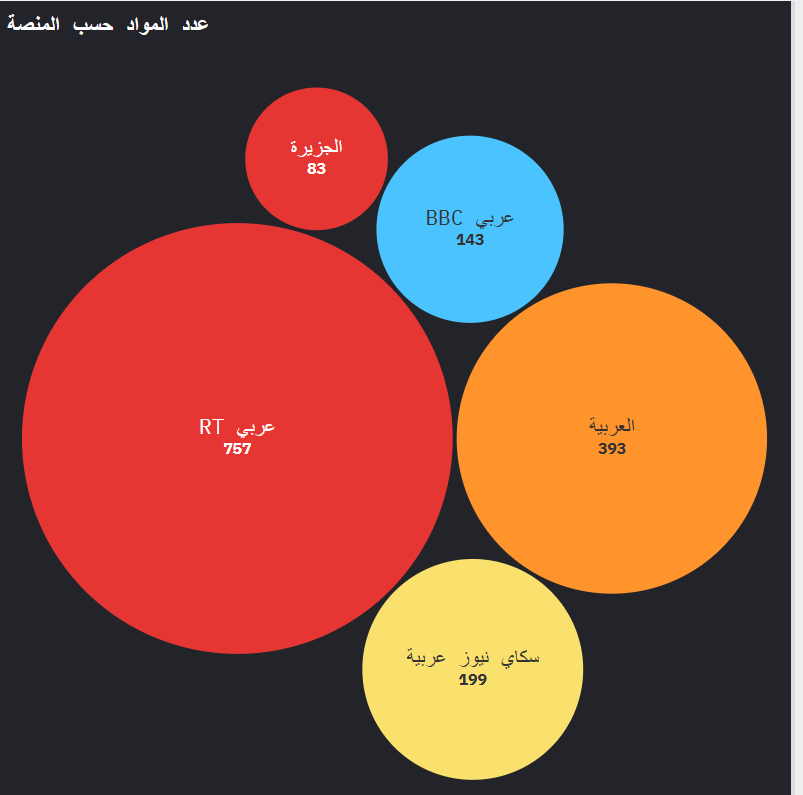
The total word count of these 1,575 articles, published between February 25 and March 6, 2026, reached approximately 2.1 million words, providing a dense sample that highlights editorial disparities between the platforms.
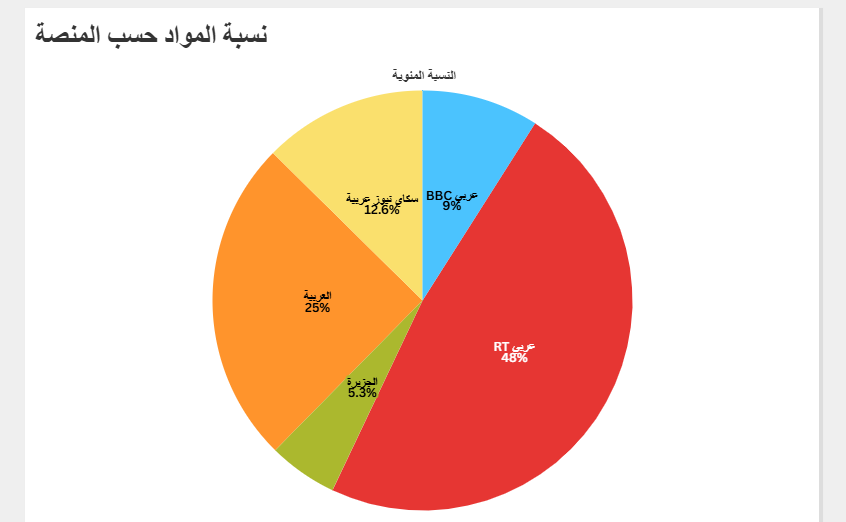
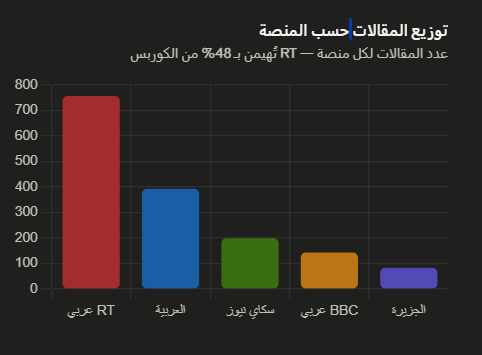
Initial data analysis shows that RT Arabic accounted for nearly half of all published material, representing 48% of the total articles (757 articles). It was followed by Al Arabiya with 25% (393 articles), then Sky News Arabia at 12.6%, BBC Arabic at 9.1%, and Al Jazeera at 5.3%. These figures indicate that the Russian platform was the most prolific content producer during the first week of the war, appearing as though it were the most prepared for the event compared to the Gulf-based platforms.
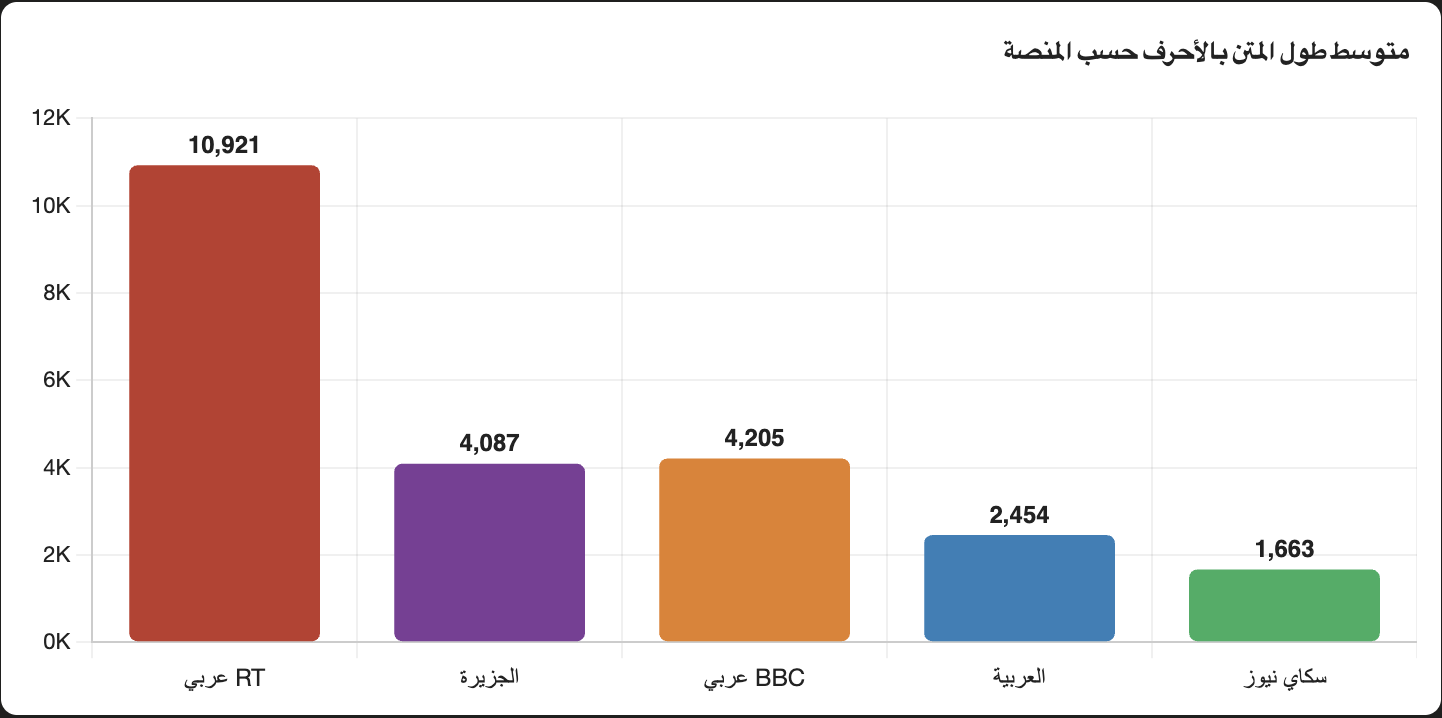
It was not just the publication volume that was notable, but also the average length of the articles published. The analysis showed that RT Arabic’s content was the longest among all platforms, with an average article length of 11,012 characters, compared to just 2,454 characters for Al Arabiya and 1,663 characters for Sky News Arabia. This means RT published material four to seven times longer than that of the Gulf-based platforms, which gave it a greater presence within the dataset.
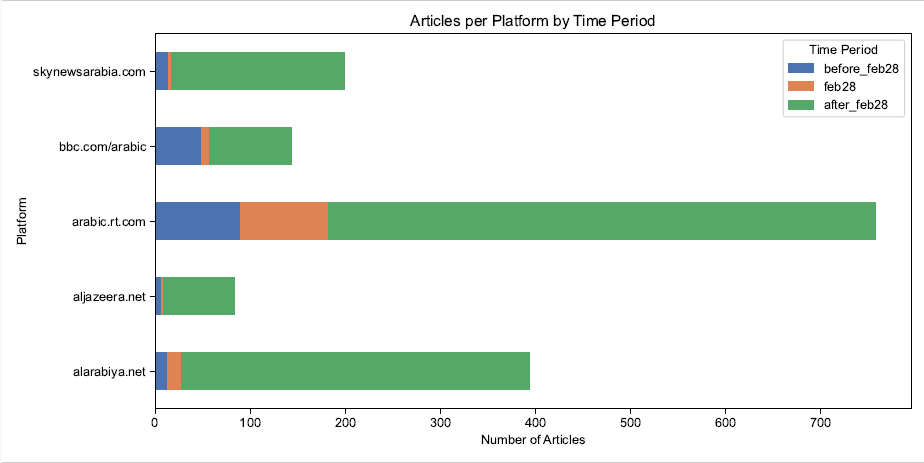
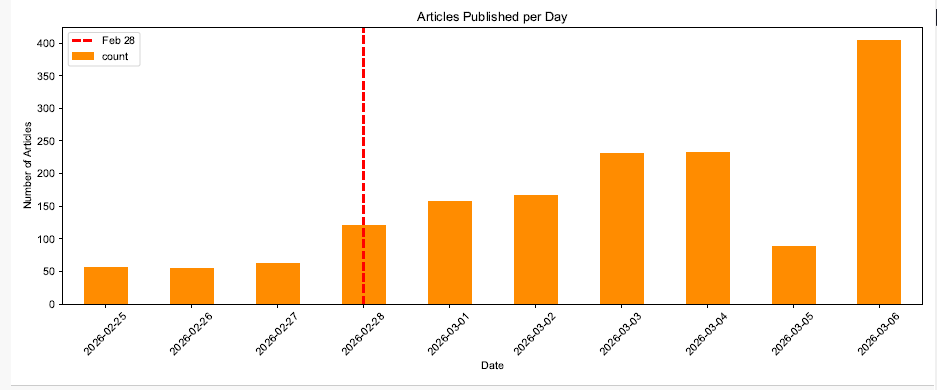
The data is divided into three distinct periods: before February 28 (172 articles, or 11%), February 28 (121 articles, 7.7%), and after February 28 (1,282 articles, or 81%). The daily publication rate jumped from 57 articles per day before the event to 183 articles after it, meaning that the majority of the data reflects material published as a reaction to developments rather than as proactive coverage.
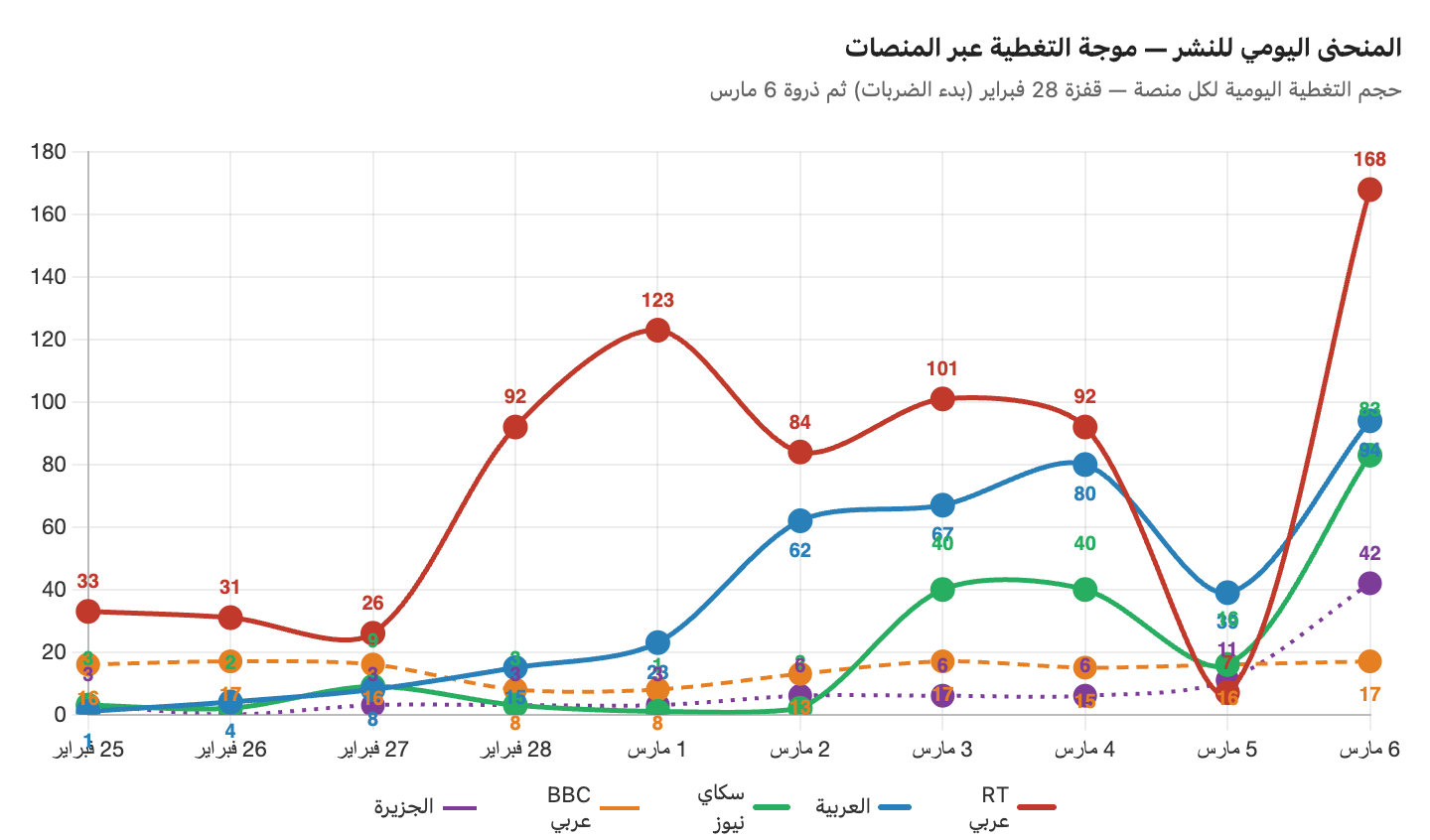
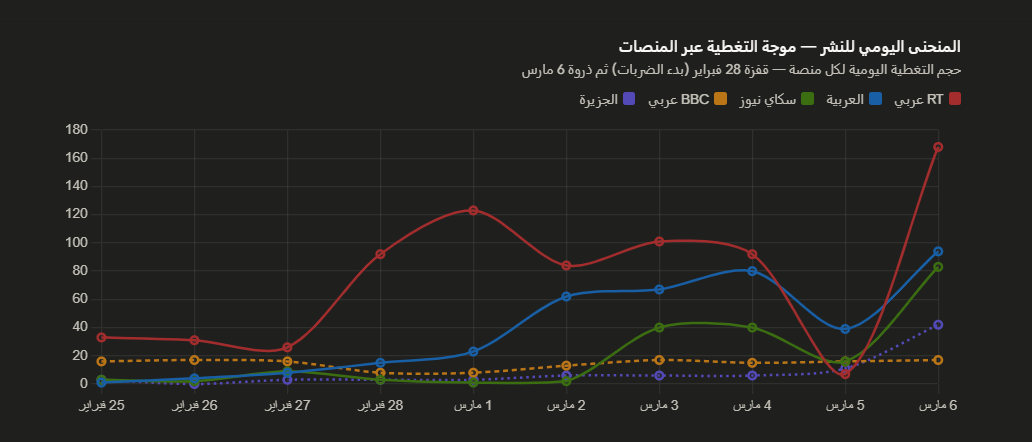
The daily trend line shows two striking peaks: the first on February 28 with the start of the strikes, when RT's output jumped to 92 articles in a single day; the second on March 6, when coverage peaked with a total of 404 articles. This analysis indicates that while RT Arabic appeared fully prepared for the event, BBC Arabic maintained a near-constant publication rate of 15 to 17 articles daily, regardless of the pace of events. Al Jazeera, meanwhile, seemed slower, as it took nearly a full week for the platform to reach its peak coverage.
Before the Bombing... A War No One Sees
Airports in the Arab region—particularly in the Gulf states, alongside Jordan and Israel—witnessed an unprecedented military buildup during the weeks preceding the US-Israeli attack on Iran, coinciding with US-Iranian negotiations in the Sultanate of Oman. However, dozens of massive military cargo planes failed to prompt any Arab newsroom to depart from its usual state of calm.
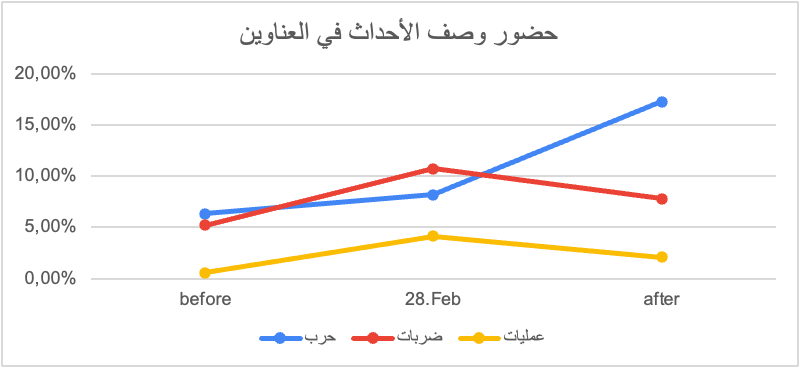
An analysis of the collected data reveals that the term "war" in its various roots and forms, appeared in only about 6% of the headlines of the press material monitored during the pre-attack phase (172 articles). The irony is that these same platforms were reporting the threats of US President Donald Trump against Iran, in which he repeatedly stated he would "strike Iran," which explains the concurrent presence of the word "strike" or "strikes" in headlines during that period.
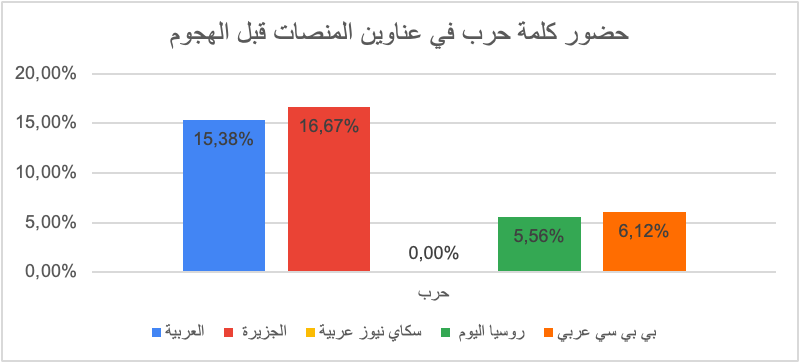
The word "strike" or "strikes" appeared in about 5% of headlines, while the word "operations" appeared in less than 1% of headlines before the attack began. These percentages provide preliminary indicators that Arab platforms tended to avoid describing what was happening as a "war" and preferred using less escalatory language, thereby maintaining a calmer image of events until the final hours preceding the outbreak of the war.
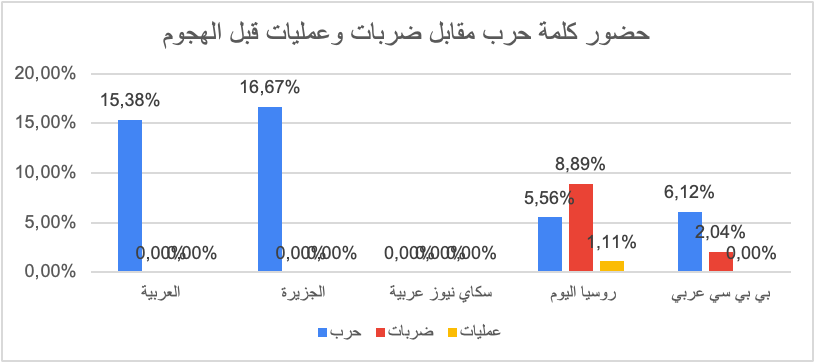
At the platform level, any mention of the words "war," "strikes," or "operations" disappeared from the headlines of Sky News Arabia during the period preceding the attack. In contrast, the word "war" appeared in about 15% of Al Arabiya’s headlines and about 17% of Al Jazeera’s headlines, with no significant presence of the words "strikes" or "operations." This indicates that both platforms treated the war as a general political topic rather than an imminent military event.
As for RT Arabic, it was the most prominent platform in using these three terms during the pre-attack phase. The word "war" appeared in about 5.5% of its headlines, while the words "strike" or "strikes" and "operations" appeared in their military sense in about 9% and 1% of headlines, respectively.
A similar coverage pattern was repeated in BBC Arabic, where the word "war" appeared in about 6% of headlines before the attack, while the word "strikes" appeared in about 2% of headlines during the same period.
The Day the War Started, But Was Not Called a War
On the morning of February 28, 2026, US and Israeli aircraft launched an unprecedented air attack on Iran, targeting the residence of the Iranian Supreme Leader, political headquarters, and military sites within the country. However, the echoes of the war were not reflected with the same clarity in the headlines of Arab platforms.
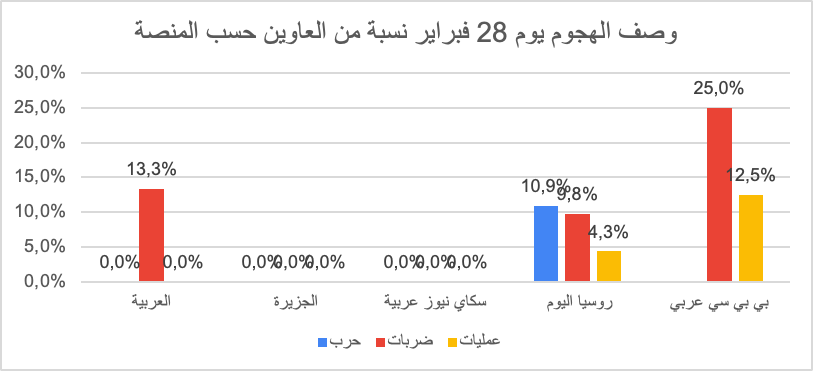
According to the analysis of the data sample, the word "war" did not appear in the headlines of any Arab platform except for RT, where the word appeared in about 11% of the headlines on the day of the attack. Conversely, the word "war" was completely absent from the headlines of Al Jazeera and Sky News Arabia, while Al Arabiya limited itself to using the word "strikes" in about 13% of its headlines that day.
The same pattern appeared in BBC Arabic, which avoided using the word "war" and replaced it with the words "strikes" and "operations," which appeared in their military sense in about 25% and 15.5% of the platform’s headlines, respectively.
The Delayed Shift From "Strikes" to "War"
After the first day of the US-Israeli attack on Iran, and with the escalation of bombing and the Iranian response using missiles and drones, the data showed that Arab platforms finally decided to use the word "war." At the same time, the use of the words "strikes" and "operations" declined in the headlines.
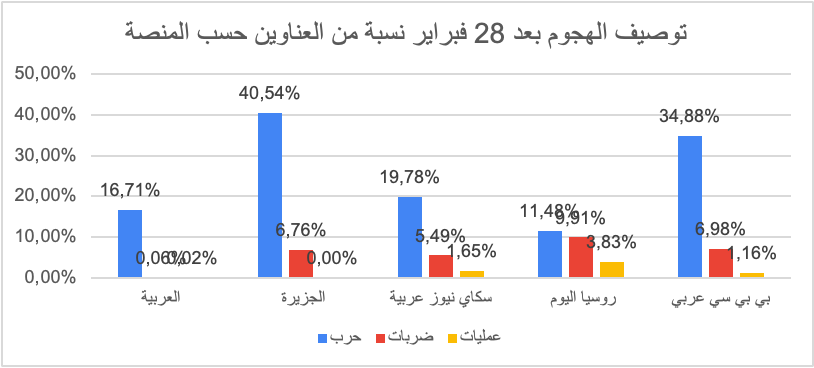
Al Jazeera led the five platforms in terms of using the word "war" in headlines during the period following February 28, as the word appeared in about 40.5% of its headlines. BBC Arabic came in second with approximately 35%, then Sky News Arabia with approximately 20%, followed by Al Arabiya with 17%, and finally RT Arabic with 11.5%.
However, RT Arabic was the only platform that maintained a degree of balance between the vocabulary of "war," "strikes," and "operations" in its headlines, while the presence of the words "strikes" and "operations" declined in most other platforms and almost disappeared from Al Arabiya's headlines.
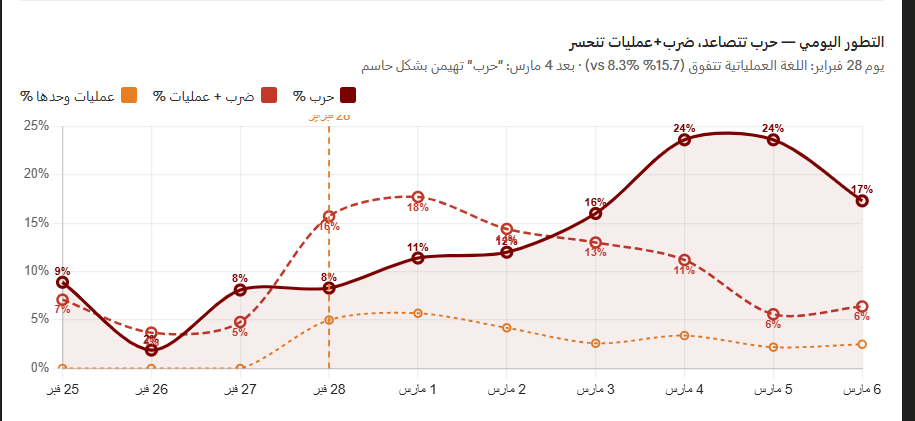
Over the entire period, extending from February 25 to March 6, the analysis showed that the presence of the word "war" gradually increased until it peaked on March 4, the day it seemed that Arab platforms had settled on characterizing the events as a war. Conversely, the use of the words "strikes" and "operations" clearly declined. But was this increasing presence of the word "war" enough to dominate the narrative of war in the headlines?
When "War" Became the Strongest Word
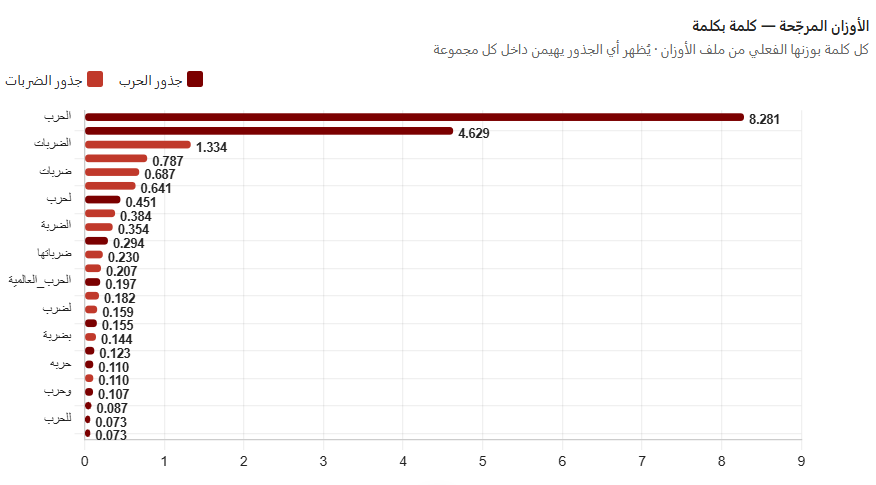
Following the commencement of US-Israeli military actions against Iran, there was a noticeable surge in the frequency of the term "war" and its linguistic variations, while more technical terms like "operations" and "strikes" saw a corresponding decrease. However, simply tracking the frequency of these terms in press materials is insufficient to gauge their true impact on news narratives. To more accurately assess how these words dominated headlines, we introduced a metric to evaluate "word weight" relative to total headline length.
This indicator measures half the count of each of the identified words divided by the total number of words in the headline; it is a formula that gives relatively greater weight to words that appear in a short headline.
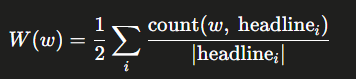
That is, the shorter the headline, the greater the weight of the word, which thus gives an indication of the word's dominance within the headline. When applying this formula to the various roots of the words "war" (harb) and "strike" (darb), it became clear that the word "war" was the most dominant in the headlines by a clear margin, followed by the word "strikes," then other derivatives of the two terms followed by a significant margin.
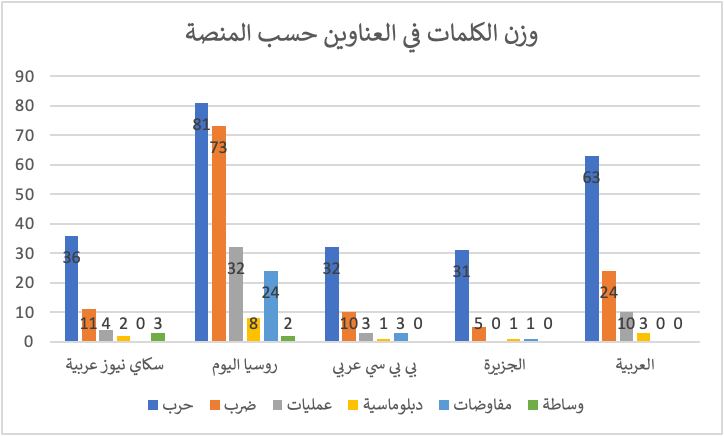
To compare the presence and dominance of these words between the different platforms, similar roots were grouped under unified semantic umbrellas, and they were compared to other words that indicate de-escalation, such as "diplomacy," "negotiations," and "mediation."
The results showed that Al Arabiya was the platform most dominated by the escalation narrative, as the word "war" received the highest relative weight, followed by the words "strikes" and "operations" with lower weights. Conversely, almost any vocabulary related to diplomacy, mediation, or negotiations was absent from its headlines, both before and after the attack.
Sky News Arabia came in the next place, as the word "war" in its headlines had a weight of approximately half the weight recorded by the word in Al Arabiya's headlines. As for Al Jazeera, despite the dominance of the word "war" in its headlines as well, it allocated space—albeit limited—for vocabulary such as "diplomacy," "mediation," and "negotiations."
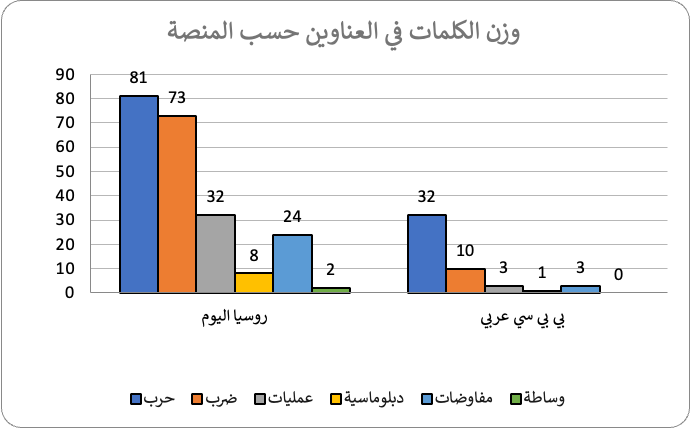
In contrast, RT Arabic's coverage seemed more balanced and diverse. The platform ranked first among the five platforms in terms of the weight of the words "war" and "strikes," and it also gave noticeable presence to vocabulary such as "negotiations," "diplomacy," and "mediation."
A similar pattern appeared, albeit to a lesser extent, in BBC Arabic, where the words "war" and "strikes" dominated the headlines, along with the presence of vocabulary such as "diplomacy" and "negotiations," but with weights much lower than those recorded on RT Arabic, and closer in nature to the Gulf platforms.
However, the high presence of the word "war" alone does not tell us what the headlines were saying. The word may appear as a general description of events, or it may appear as a direct political designation. The next question becomes more important: How did the platforms use the word "war" when they finally decided to use it?
When and How Did the Word "War" Appear in Headlines?
The question does not end at the moment Arab platforms decided to use the word "war." Between a platform saying that there is a "war," and it identifying who is launching it, who is targeting whom, and who bears responsibility for it, lies a wide space of editorial choices: in drafting the headline, arranging the actors, using the passive voice, or settling for general expressions such as "Iran's war," "the war on Iran," and "the repercussions of the war."
This section moves from the question: When did the word "war" appear in headlines? to another more important question: How did it appear? Did it come as a clear political designation for an American/Israeli confrontation with Iran, or did it appear as a military state in itself, closer to a general circumstance surrounding the region, markets, energy, and economy?
The analysis therefore did not treat every headline that used the word "war" as a complete political designation. A phrase like "the war on Iran" defines the center or arena of the event, but it does not always say who launched the war or who is managing it. In contrast, formulations such as "the American-Israeli war on Iran" or "the United States and Israel declare war on Iran" move the headline from merely describing the event to assigning it politically, because they define the actor, the target, and the direction of the action.
In this sense, the reservation in coverage was not only related to the timing of using the word "war," but also to the way responsibility was distributed within it: who appears as an actor in the headline, and who remains absent behind a general formula called "Iran's war.
War Without Clear Actors
The adoption of the term "war" by various platforms triggered a critical secondary inquiry: exactly which conflict was being referenced? Was the reporting identifying the belligerents explicitly, or merely describing a war devoid of specific actors?
An analysis of headline tagging demonstrated that the presence of the word "war" did not automatically equate to a precise political characterization. Within the final dataset of 208 unique headlines explicitly utilizing the term, 63% framed the conflict as an abstract event, a situational context, or a series of consequences. In contrast, only 32.2% of these headlines connected the war to a specific political entity, while the remaining 4.3% presented the term within citations from reports, officials, or other sources.
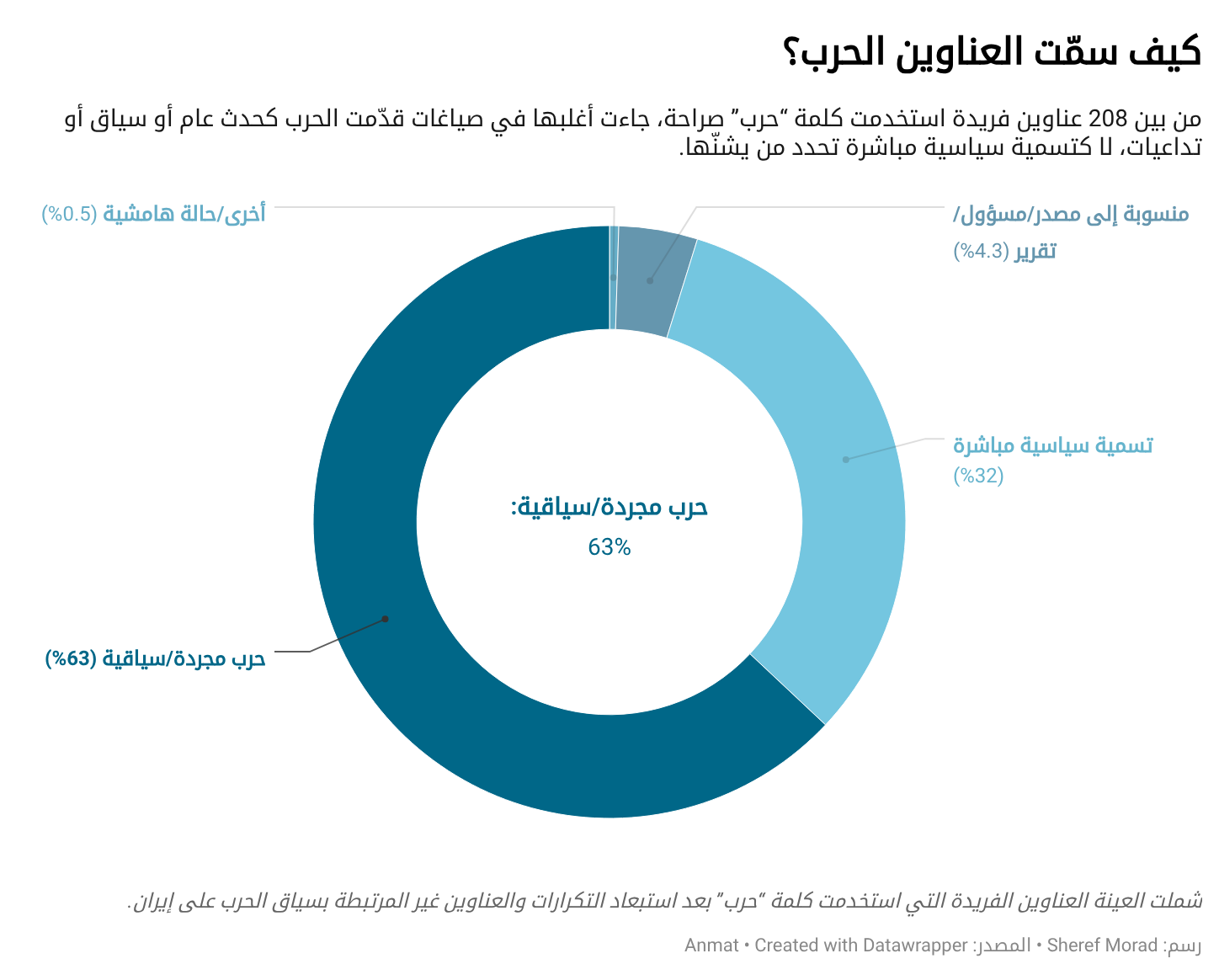
This result does not mean that the headlines ignored the war; on the contrary, the word was clearly present, but in many cases, it appeared as a general framework for the event, not a complete political designation. The headline might refer to "Iran's war," "the war on Iran," "the repercussions of the war," or "after the war," without specifying whether it was an American war, an Israeli war, or an American-Israeli war, or who was directly responsible for igniting and expanding it.
In this sense, the numbers reveal a gap between naming the event and naming it politically. The war is present in the headline, but it is not always assigned to an actor. Sometimes it appears as an economic cost, sometimes as regional repercussions, and sometimes as a temporal circumstance in which events revolve. As for the headlines that moved the war to the level of direct political attribution, they are those that used more specific formulations, such as "the American-Israeli war on Iran," or "the United States and Israel declare war on Iran."
Iran's War" Is Not Necessarily "The American-Israeli War on Iran"
In reading the headlines, merely the presence of the name "Iran" was not enough to consider the headline a complete political designation of the war. There is a difference between a headline that places Iran at the center of the event and a headline that defines the party that is launching the war on it, managing it, or declaring it.
Phrases such as "Iran's war," "the war on Iran," or "repercussions of the war on Iran" define the subject, arena, or goal of the war, but they do not always assign the action to a clear party. In these formulations, Iran appears as the center of the event or the party around which the war revolves, while the actor who started or expanded it remains outside the direct structure of the headline.
As for formulations such as "the American-Israeli war on Iran," "the United States and Israel declare war on Iran," or "the American-Israeli war with Iran," they differ fundamentally. They do not just define the arena of war; they add a clear attribution structure: parties that launch, declare, or wage, and a party upon which the action falls. Here, the war is no longer an event hanging in the air, but becomes a political action assigned to specific actors.
In this sense, the distinction in tagging was based on a simple question: Does the headline say that "there is a war going on around Iran," or does it say that "a specific party is waging a war on Iran?" The first was classified among abstract or contextual war formulas, and the second was considered a direct political designation.
The importance of this difference appears in that many headlines combined the word "war" with the name "Iran," but they did not go the extra step toward naming responsibility. The war in these cases was present as a topic or framework, not as a fully assigned action. This is what makes the question "Whose war?" necessary to understand the gap between declaring war linguistically and declaring it politically.
Five Platforms and Five Ways to Name the War
The use of the word "war" was not similar among the five platforms. While some platforms tended toward general phrases such as "Iran's war" and "the war on Iran," other platforms used headlines that were more direct in naming the actors, especially when they linked the war to the United States, Israel, or both.
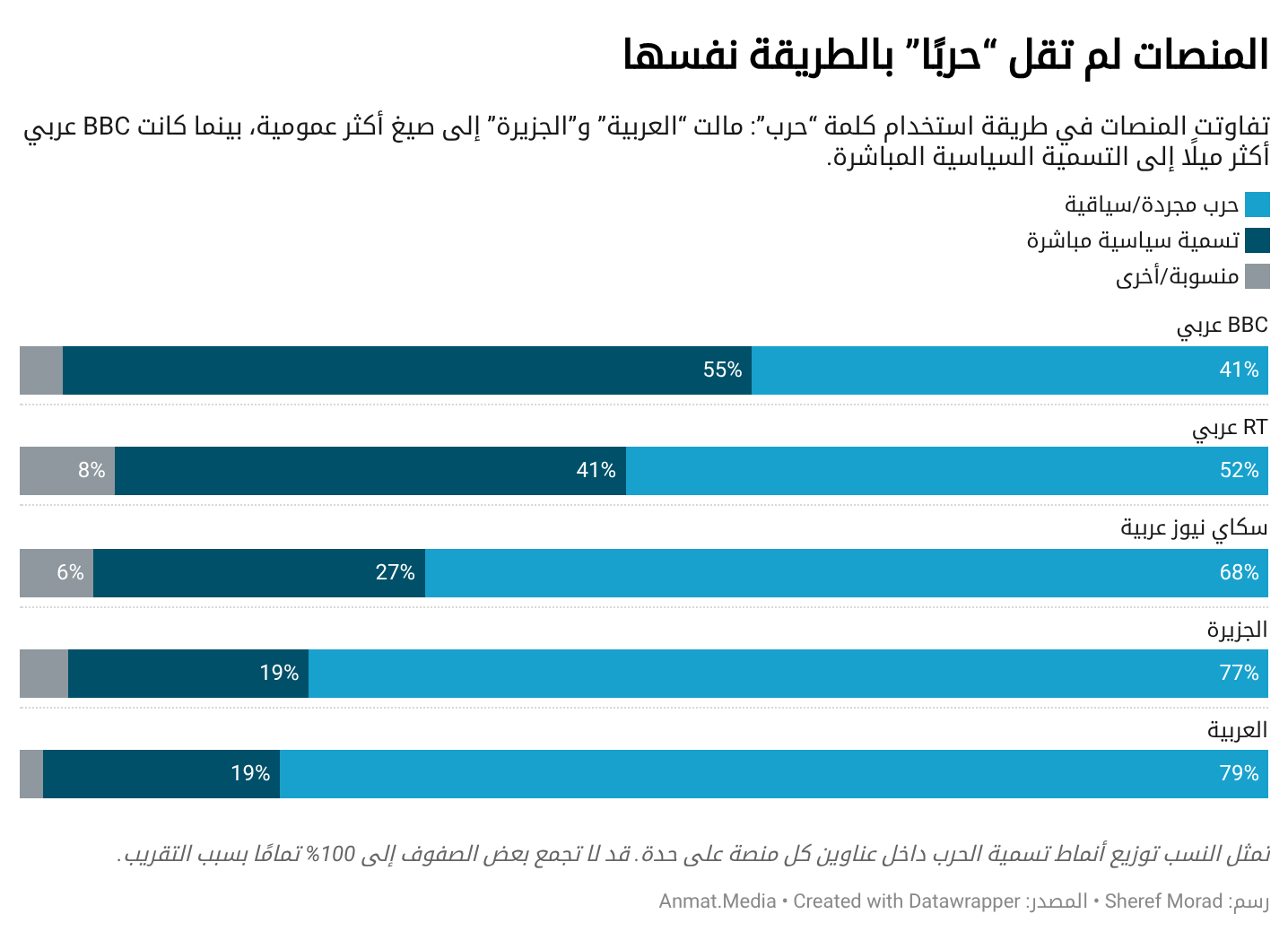
The comparison showed that Al Arabiya was the most inclined to strip the war of actors within the headline; 79.2% of its headlines that used the word "war" came in an abstract or contextual formula, against only 18.9% in a direct political designation.
Al Jazeera came close to this, as the percentage of abstract or contextual headlines reached 76.9%, against 19.2% for direct political designation.
In contrast, BBC Arabic appeared to be the most inclined toward direct political designation; this formula constituted 55.2% of its headlines that used the word "war," against 41.4% for the abstract or contextual war.
As for RT Arabic, it came in a middle position, with 51.5% of abstract or contextual headlines, against 40.9% of headlines with direct political designation.
Sky News Arabia occupied a position closer to the general pattern; 67.6% of its headlines came in an abstract or contextual formula, against 26.5% for direct political designation.
Such disparities indicate that frequency in deploying the term "war" does not equate to a willingness to specify the combatants. While one outlet might utilize the word extensively without ever identifying the entities conducting or overseeing the hostilities, another might use the term more sparingly while anchoring it to a definitive actor.
This irony appears more clearly when comparing Al Jazeera and BBC Arabic. The former used the word "war" in a large number of headlines, but it often tended toward general phrasing such as "the war on Iran" or "Iran's war." BBC seemed more direct in linking the war to its parties, through phrasing that show the United States or Israel within the structure of the designation itself.
Consequently, variations across platforms extended beyond mere publication frequency to include the linguistic structure of the narratives themselves: was the conflict depicted as a detached, abstract occurrence, or was it framed as an explicit political confrontation between a defined aggressor and their target?
Chronologically, the moment of February 28 was not just a dividing point in the density of coverage, but also in the way of naming the war within the headlines. Before this date, the headlines that used the word "war" were relatively limited, and they were dominated by hesitation between expectation, warning, and preparation. During this phase, 55.6% of war headlines came in an abstract or contextual formula, against only 22.2% in a direct political designation formula, while 22.2% of headlines were attributed to a source, official, or statement.
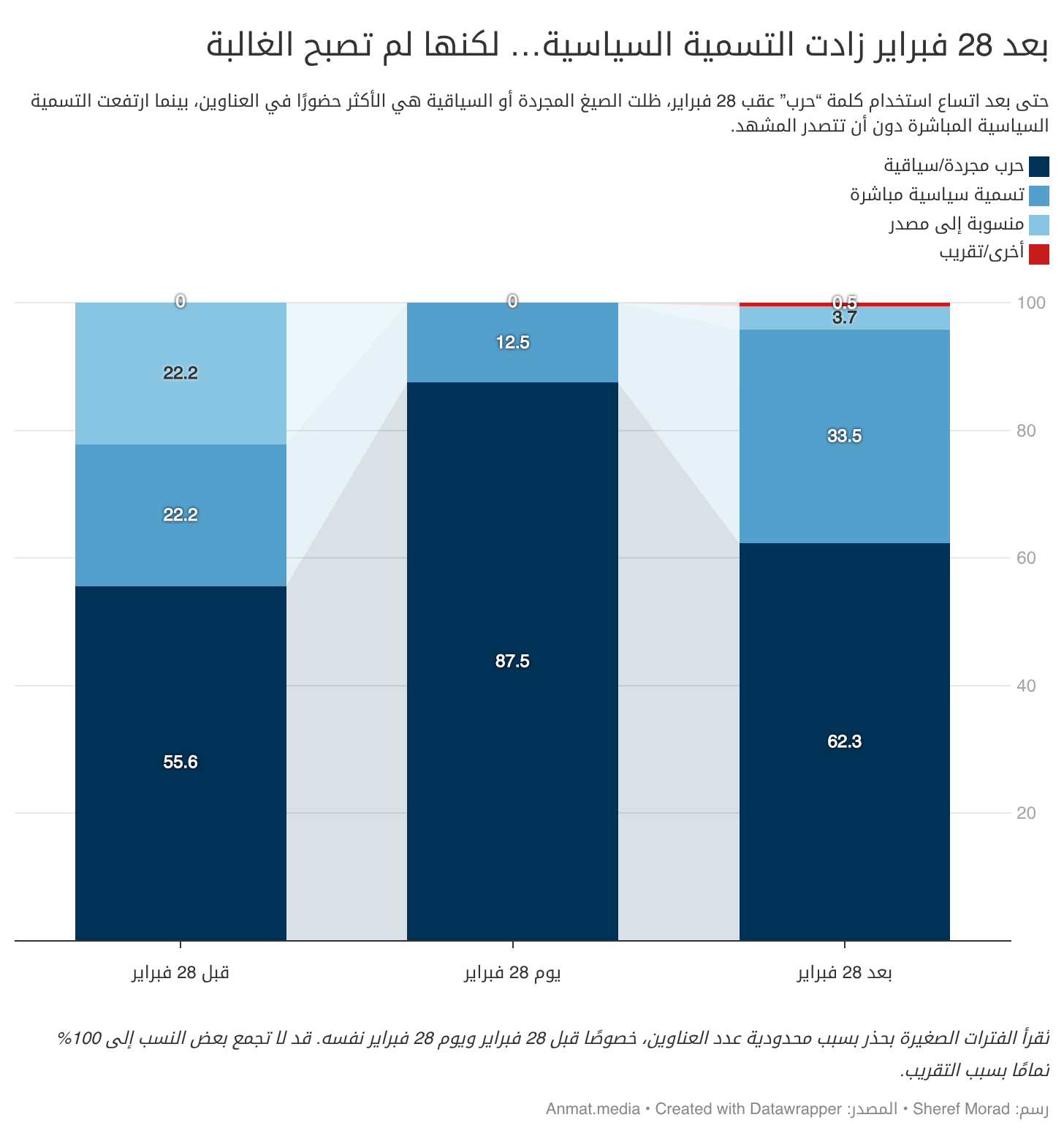
But February 28 itself seemed a moment of linguistic transition more than a moment of political resolution within the headline. The need to use the word "war" increased, but the structure of attribution remained cautious. On that day, 87.5% of war headlines came in an abstract or contextual formula, against only 12.5% in a direct political designation formula. That is, the word appeared, but the political actor did not appear with it with the same clarity.
After February 28, and with the expansion of coverage and the stabilization of characterizing the event as a war in a larger number of headlines, the percentage of direct political designation increased to 33.5%. But this increase did not change the general trend; abstract or contextual formulas remained the dominant ones, at 62.3% of war headlines, while headlines attributed to sources or officials declined to 3.7%.
This temporal movement reveals that the transition of the platforms from the language of "escalation" or "strikes" to the language of "war" was not a complete transition toward direct political designation. Even after the war became a clear framework for coverage, it continued to be presented in most headlines as a general state: an ongoing war, or a war on Iran, or repercussions of a war, or an expansion of the war; not always as an action clearly attributed to the United States or Israel or both.
In this sense, February 28 was not the end of linguistic hesitation, but the beginning of a new phase of it; a phase in which the description of "war" became more acceptable in the headline, while defining the political actor varied between one platform and another, and between one formula and another.
Transformation From “War” to “Repurcussions”
Abstraction does not appear in the headline only when the names of the United States or Israel are absent, but also when the war turns from a political action into a general framework upon which the rest of the news is hung. In these phrasings, the question is not: Who launched the war? But rather: What did the war do to the markets? What did it change in the region? How much did it cost? And when will it end?
One of the most prominent patterns of this abstraction was presenting the war as an economic shock. In headlines of this type, the war becomes a cause for market turmoil, rising oil prices, changes in air traffic, or exercising new pressures on the global economy. Here, the structure of actor and object recedes, and the war appears as a pressing economic variable: "Iran's war" shakes the markets, or "the repercussions of the war" extend to energy, gold, and prices. The war is not narrated as a political decision or a military action with assigned responsibility, but as a wave of effects moving from the front to the economy.
A further abstraction involves portraying the conflict as a mere temporal backdrop. Using markers like "during the war," "since the war began," or "on the war's fourth day," news platforms treat it as a period of time in which other incidents occur. This linguistic approach solidifies the war's existence as a static reality but avoids naming the instigator or the entity controlling its trajectory. Rather than questioning the root of the military actions, such headlines utilize the war as a chronological anchor to categorize and order incoming reports.
"
"
There is also war as a set of repercussions. In these headlines, phrasing such as "the repercussions of the war," "the effects of the war," "the risks of the war," "the cost of the war," and "the expansion of the war" are repeated. This language shifts the focus from the moment of action to its results; the important thing becomes the losses, turmoil, regional fears, economic confusion, or the threat of the confrontation that the war leaves behind. Once again, the war appears as an entity that has effects and a course, more than it appears as an action emanating from a clear political party.
The fourth pattern is presenting the war as an independent entity: "Iran's war," "the war on Iran," "the Middle East war," or "the panorama of the first week." In these formulas, the war seems as if it is a subject in itself, having developments, chapters, and scenes, not a specific political relationship between an actor and a target.
While such headlines might be explained by the need for journalistic brevity, they produce a significant linguistic consequence: "war" becomes a broad noun representing the event rather than a precise term that defines the underlying structure of accountability.
Through these various framing techniques, "war" was often reduced to a set of circumstances, costs, or repercussions, or treated as an isolated entity. This distinction is far from a minor linguistic detail; the terminology used to name a conflict dictates whether the audience recognizes a specific political act and its perpetrators or merely perceives the resulting impact as it spreads globally and across the region.
Iran as the Focal Point: Actors Recede into the Background
To validate our manual headline classification, we cross-referenced our findings with automated association rule mining. This map served as a secondary verification layer rather than a primary guide.
The automated results reinforced our editorial insights: contextual associations related to the conflict were far more prevalent than those naming specific political actors. When analyzing the term "war," its most frequent association was with "Iran." While explicit attributions—such as "American-Israeli war"—did appear, they were not the dominant pattern. Crucially, linking "war" with "Iran" defines the arena of the conflict but often fails to assign political responsibility or identify the instigators.
While automated analysis has limitations, such as occasionally flagging statistically strong but linguistically fragmented patterns, it reinforced our core conclusion: although Arab news platforms increasingly adopted the term "war," they consistently avoided naming the political entities responsible, favoring broader, less specific framing.
Prepared by: Ibrahim Helal - Sherif Morad