Prepared by: Sharif Murad
Arabi Facts Hub
is a nonprofit organization dedicated to research mis/disinformation in the Arabic content on the Internet and provide innovative solutions to detect and identify it.
In times of crises, facts alone do not shape the course of events; the way news is told, the headlines that are repeated, and the angles chosen by different platforms to interpret what is happening also play a role. Hence, this series of data-driven analytical reports is the result of a collaboration between Arabi Facts Hub and independent research initiative "Anmat," aiming to examine Arab media coverage of the war on Iran and monitor how competing narratives were formed through media and digital platforms.
The series includes six journalistic stories built on a database prepared and analyzed by the Anmat team, based on the content of five widely circulated and influential Arabic-language digital platforms: BBC Arabic, RT Arabic, Al Jazeera, Sky News Arabia, and Al Arabiya. The work involved collecting materials published during the three days preceding the U.S.-Israeli strike, and then the first seven days of the war, between February 28 and March 6, using open-source Python libraries.
The analysis relied on the Association Rule Mining (ARM) method to study headlines and body text at several levels, including monitoring the most frequent words, analyzing repeated linguistic structures and measuring their prevalence, and then extracting prevailing patterns with statistical indicators that clarify the strength and presence of each pattern, while taking into account differences in publication volume between the various platforms. The results were also read collectively, at the level of each platform, and according to temporal shifts in coverage.
Based on this data, the editorial team at Arabi Facts Hub worked on reviewing the findings, analyzing and interpreting them through a journalistic lens, then building reports that do not merely present numbers but attempt to understand what lies behind them: How did media platforms differ in covering the event? What were the most present narratives? And how were political stances reflected in language and headlines?
These reports do not claim to offer final judgments, but they seek to provide a deeper reading of the media landscape during the first week of the war, by combining data analysis with editorial vision, to understand how news is made and how its meaning is reshaped in moments of conflict.
In this article
We look beyond the surface of Arab media coverage regarding the war on Iran. While identifying what was said or how frequently Iran appeared in headlines is a vital starting point, these metrics do not fully reveal the architecture of the narrative. To understand how the story is truly built, we must address a more fundamental question: when a news outlet anchors a headline with an attributed source, whose voice is being prioritized?
This article investigates the "opening voice" within headlines: the entity, person, institution, or media intermediary called upon at the beginning of a story to provide the reader with their entry point into the event. Does the narrative begin from Washington, Tel Aviv, Tehran, the Revolutionary Guard, or Western reports? Or do some platforms avoid explicit attribution in headlines altogether?
In this sense, we are not only examining what was said about the war, but also who was granted the right to speak about it in the headline itself.
Beyond Linguistic Form: A Map of Voices
The analysis relied on a sample of 1,575 headlines published across five Arabic-language platforms: RT Arabic, Sky News Arabia, Al Arabiya, BBC Arabic, and Al Jazeera. The study was conducted through the use of an analytical database and outputs developed by Anmat, which specifically focused on the media's reporting of the war on Iran.
Since the primary objective of this study is to examine attributed voices rather than just general mentions of various parties, an automated classification system was employed to identify explicit forms of attribution within the headlines. This process specifically targeted headlines that featured names or descriptors representing a definite source of information or a formal statement, encompassing entities such as presidents, official institutions, military forces, the Revolutionary Guard, the White House, the Pentagon, news agencies, newspapers, specific reports, or other cited sources.
The analysis omitted headlines where a military or political entity was mentioned solely as a participant in an action without clear attribution. For instance, a headline reporting that "Israel bombed" or "Iran warned" would not be categorized as attributed unless it included a specific voice or source responsible for the claim or information.
Following the exclusion of materials unrelated to the conflict or its direct consequences, 1,111 headlines were retained for the study. From this pool, 385 headlines were identified as containing distinct attributed voices or clear attribution.
In this sense, the analysis does not measure everything said within the full texts, nor does it claim to capture all forms of implicit attribution; rather, it focuses on what appears at the forefront of the news: the voices that the platforms have chosen to place within the headline itself.
How Did We Read the Indicators?
We did not treat words merely as raw repetitions. The appearance of a word such as "Iran," "Israel," or "response" on its own is not sufficient to conclude that a platform adopts a particular narrative. The more important question is: What does the word appear in as? How consistently does it appear in that context? And is this association incidental, or stronger than chance?
For this reason, the analysis relied on three key indicators in association rule analysis: Support, Confidence, and Lift. These indicators complement one another.
Support measures the prevalence of a pattern within the sample: does this linguistic association appear in a substantial number of headlines or sentences, or is it a rare pattern? It is an indicator of scale and prevalence, not merely the strength of a relationship.
Confidence measures the relationship in one direction. For example, if a particular actor appears in a headline, how often does a specific verb or description appear alongside it? It is not enough to say that two words appear together; we must ask whether the appearance of the first generally leads to the appearance of the second. This is important because the relationship "Iran → response" is not necessarily equivalent to the reverse relationship "response → Iran."
Lift is the most sensitive indicator for identifying editorial particularities. It does not simply ask whether a pattern appears; it asks whether it appears more often than would be statistically expected if words were distributed normally. In other words, an association may be limited in prevalence yet still be significant because it appears with a particular platform, actor, or context at a higher-than-expected rate.
For this reason, no numerical value was interpreted in isolation. A high Support value may indicate that a pattern is widespread, but it does not necessarily mean that it is distinctive or exceptional. A high Confidence value may indicate a strong association, but within a limited pattern. A high Lift value may reveal a distinctive relationship, but its scale must always be examined to avoid overstating the importance of a marginal pattern.
Because publishing volume varies across platforms, the analysis used an equally weighted average across them in the overall reading, so that the aggregate result would not simply reflect the platform that published the most content. The objective was not to determine who published more, but rather to identify whether there were patterns in the distribution of voices that appeared across platforms or were unique to a particular platform.
The journalistic reading thus relied on a simple principle: a pattern becomes stronger when it combines sufficient prevalence, a clear directional relationship, and an association that is higher than expected. A pattern that exhibits a high Lift value alone, without meaningful prevalence, was treated as an indication requiring cautious interpretation rather than a definitive finding.
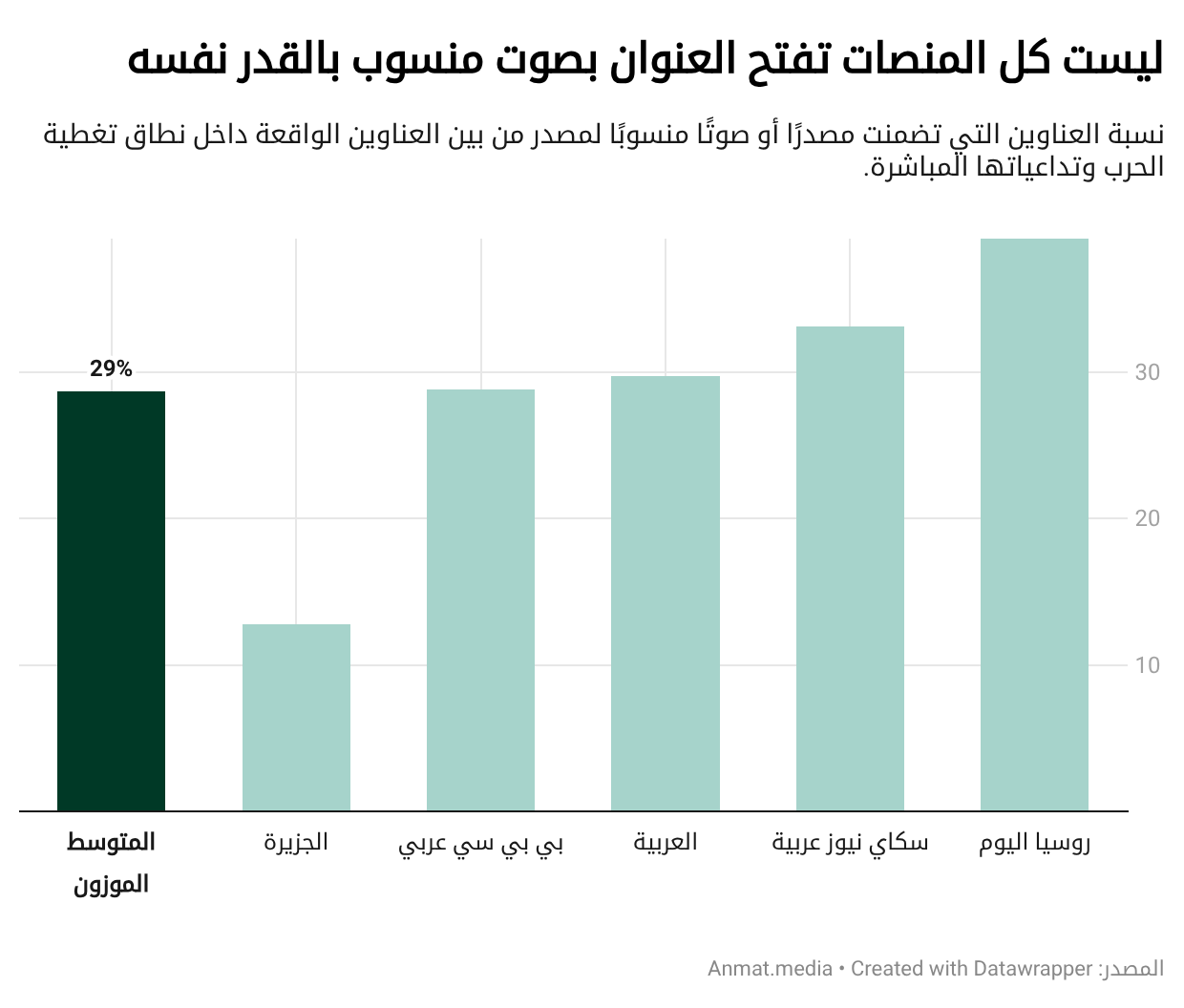
The analysis showed that the use of explicit attribution within headlines is not distributed equally across platforms. Among the headlines included in the analysis, attribution formulas or attributed voices appeared in 39.1% of headlines published by RT Arabic, compared with 33.1% for Sky News Arabia, 29.7% for Al Arabiya, and 28.8% for BBC Arabic. The proportion dropped to just 12.8% for Al Jazeera.
Because the number of headlines varies considerably between platforms, the analysis used an equally weighted average across them, which stood at 28.7%. Relative to this average, RT Arabic emerged as the platform most inclined to use attribution in headlines, with a Lift score of 1.36, followed by Sky News Arabia with a score of 1.15. Al Arabiya and BBC Arabic were both close to the average, while Al Jazeera fell well below it, with a score of 0.44.
This finding does not mean that one platform is more professional than another, nor is it sufficient on its own to indicate political bias. Rather, it reveals differences in the construction of the news headline. Some platforms tend to open headlines through a clearly identified voice: an official making a statement, a military announcing an action, an institution confirming information, or a report revealing details. Other platforms appear less reliant on this approach, preferring headlines that describe or summarize an event without direct attribution.
In this sense, the first point of divergence lies not only in who speaks, but also in the extent to which attributed speech is present in a platform’s headlines in the first place.
In BBC Arabic, the analysis identified 23 headlines with clear attribution. Within this limited sample, Israeli voices appeared above the weighted average, with a Lift score of 1.78, followed by American voices with a score of 1.50, while Iranian voices were close to the average, with a score of 0.96. These figures suggest a tendency within BBC Arabic’s attributed headlines to open the narrative through American and Israeli voices more often than others. However, the small sample size does not allow this pattern to be generalized with confidence.
The picture is different for Al Jazeera. The analysis identified only six headlines with clear attribution out of all headlines included in the study. As a result, the distribution of source types within this limited sample is not sufficient to establish a clear pattern regarding who speaks in its headlines. The more notable finding here is the low level of explicit attribution itself: it appeared in only 12.8% of headlines, the lowest proportion among the platforms, corresponding to a Lift score of 0.44.
Sky News: U.S. Voices and Media Reports Predominate
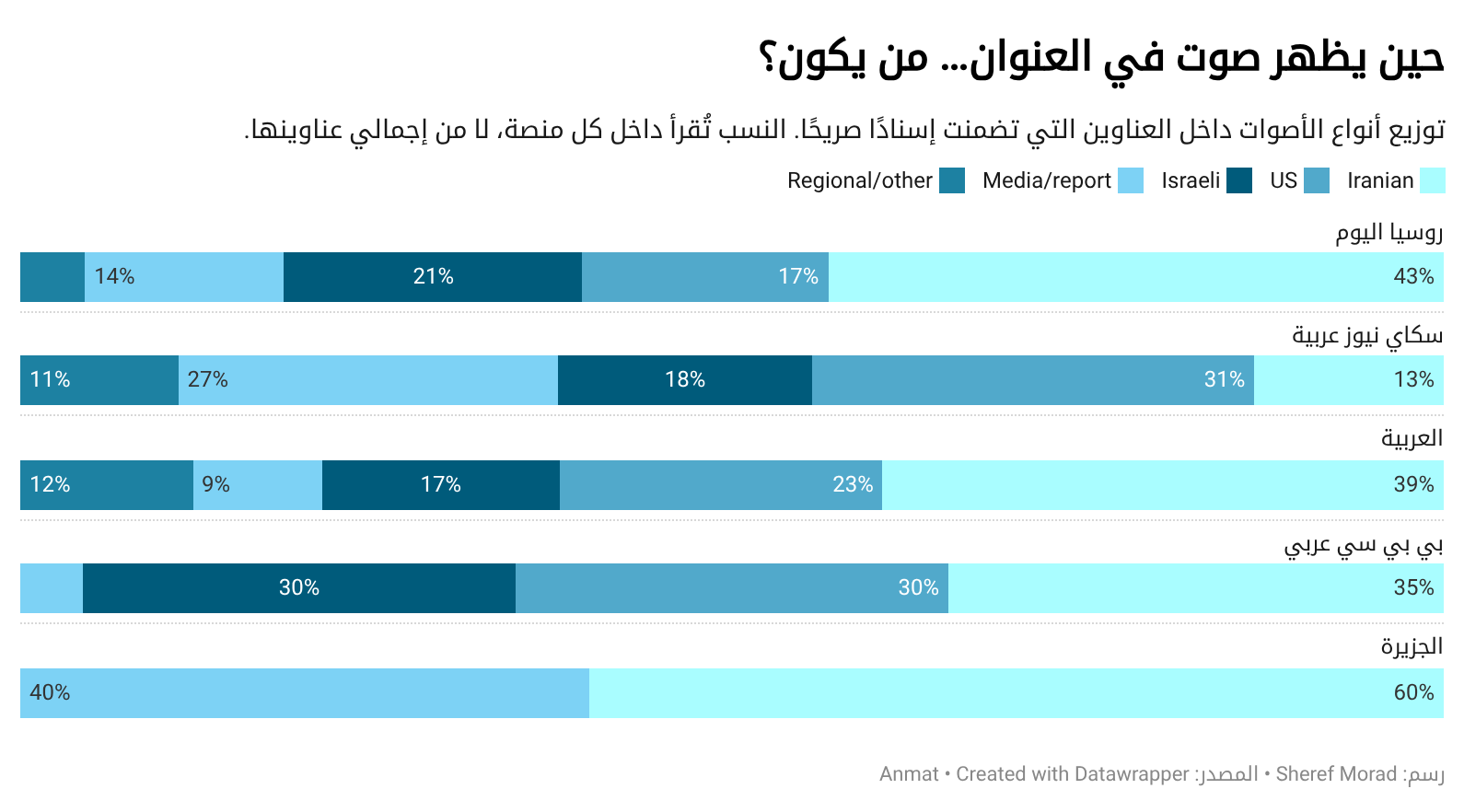
Sky News Arabia presents the clearest case in the sample when moving from the question of “How often does attribution appear?” to “Which voice appears when attribution is present?” Within attributed headlines, official or institutional American voices accounted for 31.1%, followed by reports and media outlets at 26.7%, then Israeli voices at 17.8%. Iranian voices, by contrast, accounted for no more than 13.3%.
The significance of this finding lies not only in the percentages themselves, but also in their comparison with the weighted average across platforms. American voices appeared above the average, with a Lift score of 1.53, as did reports and media outlets with a nearly identical score. Iranian voices, meanwhile, fell well below the average, with a Lift score of 0.37.
This suggests that when Sky News Arabia chooses to include an attributed voice in a headline, it does not distribute that attribution evenly among the parties to the conflict. Instead, it tends to introduce the reader to the story through American voices or media reports—often international or Western ones—more frequently than through direct Iranian voices.
This does not mean that Iranian voices are entirely absent from Sky News Arabia’s headlines. Rather, they appear with less weight than would be expected relative to other platforms. By contrast, Washington, American institutions, and media reports appear more likely to open the story and shape the reader’s point of entry into it.
RT Arabic and Al Arabiya: Iranian Voices Are Prominent, but to Varying Degrees
Unlike Sky News Arabia, American voices and media reports do not emerge as the primary entry point into RT Arabic's headlines. Within attributed headlines, official Iranian voices appeared above the weighted average, with a Lift score of 1.19. Israeli voices also appeared slightly above the average, with a score of 1.21. American voices, by contrast, fell below the average, with a score of 0.85, as did media reports, with a score of 0.79.
These findings suggest that RT Arabic does not structure its narrative around Iranian voices alone. Rather, it gives Iranian and Israeli voices relatively greater prominence in the headline space compared with American voices or media intermediaries. In other words, its attributed headlines appear more closely tied to direct parties to the confrontation—Tehran and Tel Aviv—than to Washington alone or to intermediary media sources.
Al Arabiya, by contrast, presents a more balanced pattern. Iranian voices appeared close to the average, with a Lift score of 1.09, as did American voices at 1.12. Israeli voices were also near the average, with a score of 0.97. Most notable, however, was the prominence of regional or Gulf voices, which exceeded the average by a considerable margin, with a Lift score of 2.19. Media reports, meanwhile, appeared less frequently than expected, with a score of 0.52.
According to this reading, Al Arabiya is less closely associated with a single dominant pattern. It does not resemble Sky News Arabia in its clear preference for American voices and media reports, nor does it resemble RT Arabic in its relatively elevated emphasis on Iranian and Israeli voices. Rather, it appears to open attributed headlines through a mix of Iranian, American, and regional voices, with a more pronounced role for Gulf and regional actors in framing the war and its repercussions.
These findings do not point to a single source dominating the narrative of the war on Iran across Arab media. Instead, they reveal a more complex picture. When platforms choose to include an attributed voice in a headline, they differ both in how they make that choice and in how they distribute prominence among competing voices.
Sky News Arabia appears more inclined toward American voices and media reports, with a comparatively weaker Iranian presence. RT Arabic appears more closely aligned with the voices of the direct parties to the confrontation, particularly Iranian and Israeli actors. Al Arabiya presents a more mixed model, with a clearer role for regional voices. BBC Arabic's sample, meanwhile, suggests a relative tendency toward American and Israeli voices, while Al Jazeera remains the platform least reliant on explicit attribution.
In this sense, it is not enough to ask: What did the headlines say about the war? We must also ask: Who was called upon to speak about it? And who was placed at the forefront of the story? A headline does not merely convey what happened; it sometimes determines who gets to tell their story first.
Prepared by: Sharif Murad