Prepared by: Ibrahim Hilal
Arabi Facts Hub
is a nonprofit organization dedicated to research mis/disinformation in the Arabic content on the Internet and provide innovative solutions to detect and identify it.
In times of crises and wars, facts alone do not shape the course of events. Narrative also plays a significant role. This series of data-driven analytical reports is the result of a collaboration between the Arabi Facts Hub (AFH) and the independent research initiative Anmat, aimed at monitoring competing narratives surrounding the Iran war across digital media. The series includes six journalistic stories built on a database collected by the Anmat team from five widely circulated digital platforms (BBC Arabic, RT Arabic, Al Jazeera, Sky News Arabia, and Al Arabiya) during the period from February 28 to March 6, using open-source Python libraries.
The analysis relied on the Association Rule Mining (ARM) method to study headlines and body texts, monitor recurring linguistic structures, and extract prevailing patterns with statistical indicators that clarify their overall strength, timing, and presence per platform. Based on this data, the AFH editorial team reviewed the results and provided a journalistic interpretation to understand the behind-the-scenes coverage and the impact of political positions on language and headlines, aiming to offer a deeper reading of the media landscape and how news is shaped. Those who wish to read the full methodology can do so via this link.
These reports do not claim to offer final judgments, but they seek to provide a deeper reading of the media landscape during the first week of the war, by combining data analysis and editorial insight to understand how news is made and how its meaning is reshaped in moments of conflict.
In this piece
We show that coverage did not present a unified voice to the public. Instead, priorities varied between platforms that focused on developments on the ground and others that presented the event from a broader economic and political angle, reflecting a clear difference in the understanding of the war and the framing of its meaning in the media.
The analysis results show that terms related to oil, markets, and prices were present in headlines and body texts at a much higher frequency than terms related to deaths, injuries, and human casualties, especially on some Gulf platforms. By tracking word frequency and prevalence indicators, the report discusses how the language of economics overshadowed the human dimension, and how the conflict, in part of the coverage, transformed from a war tragedy into an energy and market crisis, in which oil appeared louder than blood.
The Report:
On February 25, 2026, signs of military escalation began to appear on the horizon of the Middle East, before events exploded on the 28th of the same month with an unprecedented attack on Iran. Within just ten days (from February 25 to March 6), Arab newsrooms turned into active monitoring platforms, following the developments of the event moment by moment. However, these reports did not present a single, unified narrative of the war.
By collecting and analyzing 1,575 news articles that documented the details of the conflict across five major news platforms, as part of the Anmat project database—which monitors recurring linguistic patterns in headlines and texts. These outputs are not used as final judgments, but rather as a map to help track narratives within the original news and compare them across different platforms and time periods, as the data shows the structure of repetition more than it offers a ready-made interpretation.
The data revealed that the narrative presented to the public was not uniform; rather, it split into multiple narratives, with priorities varying between the humanitarian and economic dimensions. The coverage was stained with the color of oil, ignoring—intentionally or unintentionally—the blood of hundreds of victims.
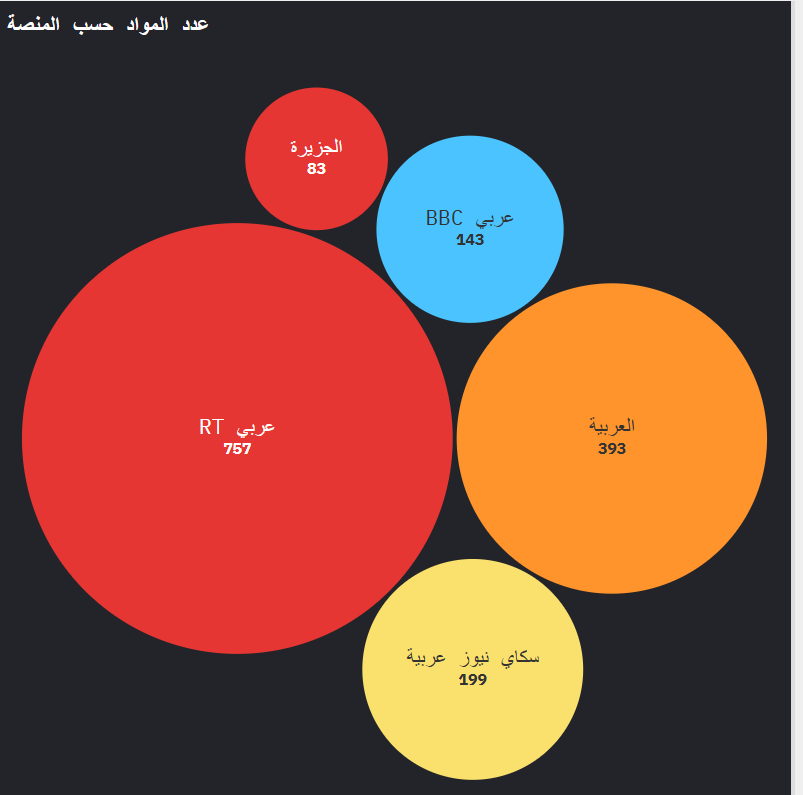
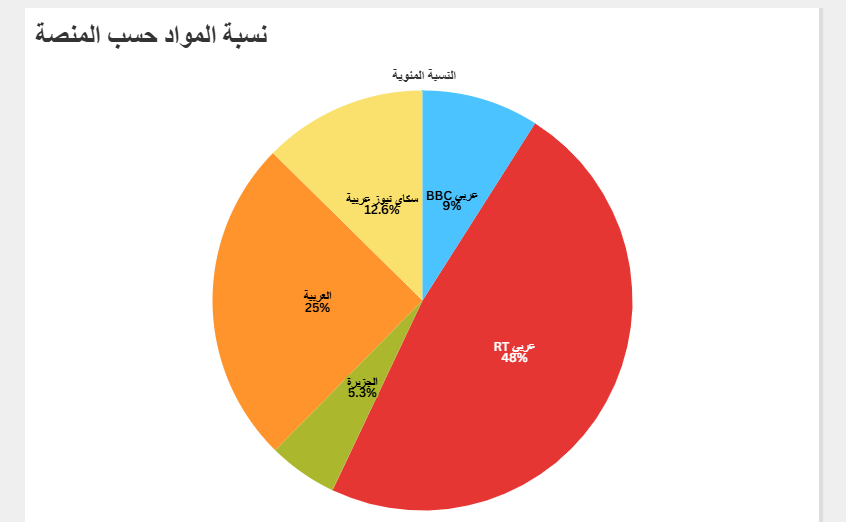
Quantitative data extracted from media coverage shows that the volume of journalistic production was not distributed equally; RT Arabic led the scene with a 48% share of total coverage (757 articles), followed by Al Arabiya at 25% (393 articles), then Sky News Arabia at 12.6% (199 articles). Conversely, BBC Arabic published 143 articles (9%), while Al Jazeera came in last with only 83 articles (5.3%).
Chronologically, the coverage went through three main stages. Before the attack (February 25–27), there was a cautious calm with an average of 57 articles per day. On the day of the event, February 28, the number doubled reaching 121 articles, signaling the start of the escalation. However, the actual peak was not on the day of the attack, but on March 6, when the number of articles reached 404 in a single day.
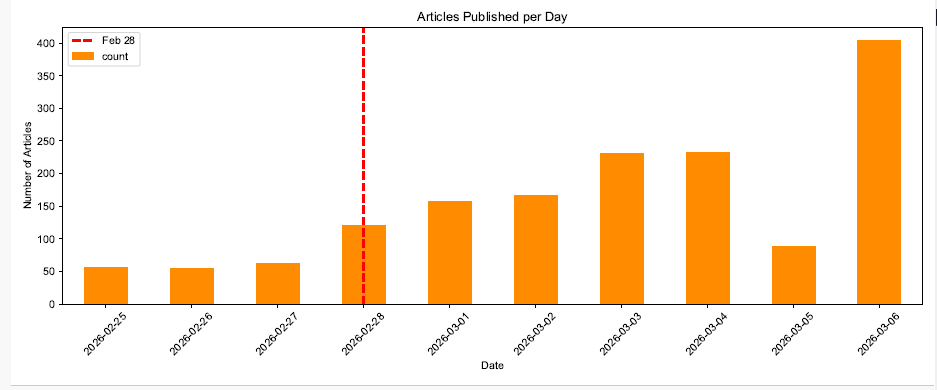
This delay in reaching the peak raises questions about the nature of the coverage: was the press keeping up with the military event as it happened, or was it occupied with covering its political and economic repercussions, which crystallized later?
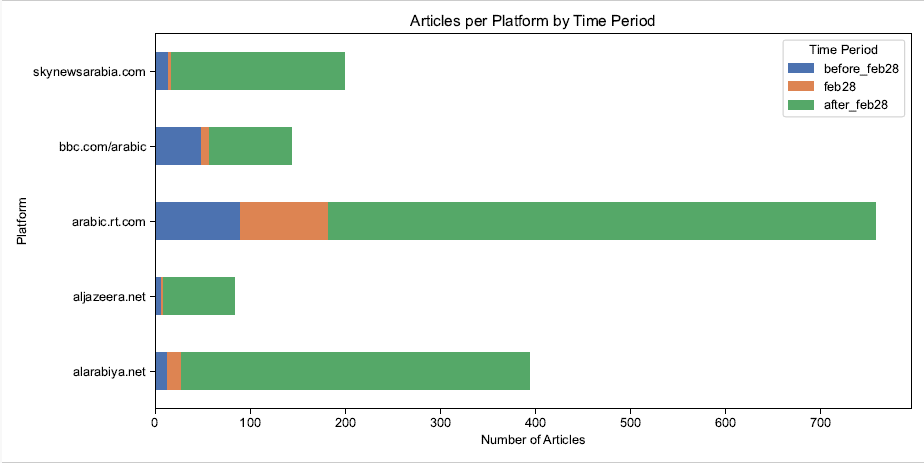
This investigative report delves into the analysis of 1,575 news articles, using data analysis tools, association rules, and statistical prevalence indicators to dismantle the narrative frameworks adopted by the five platforms. The report focuses specifically on how the Gulf press handled the “oil and blood” duality, revealing how the language of markets and prices dominated at the expense of victims and human losses, coverage where the economic indicator seemed louder than the sound of explosions.
Word Frequency: Numbers Reveal Priorities
Vocabulary choice in journalism serves as more than a descriptive tool; it acts as a window into the underlying priorities of an editorial team. An analysis of 1,575 news articles highlights a surprising focus in media coverage, even as the war's opening week was marked by intense U.S.-Israeli strikes on Iran. The data indicates a systematic pattern where "oil" became the dominant narrative focus, consistently overshadowing the human cost of the war by a significant margin.
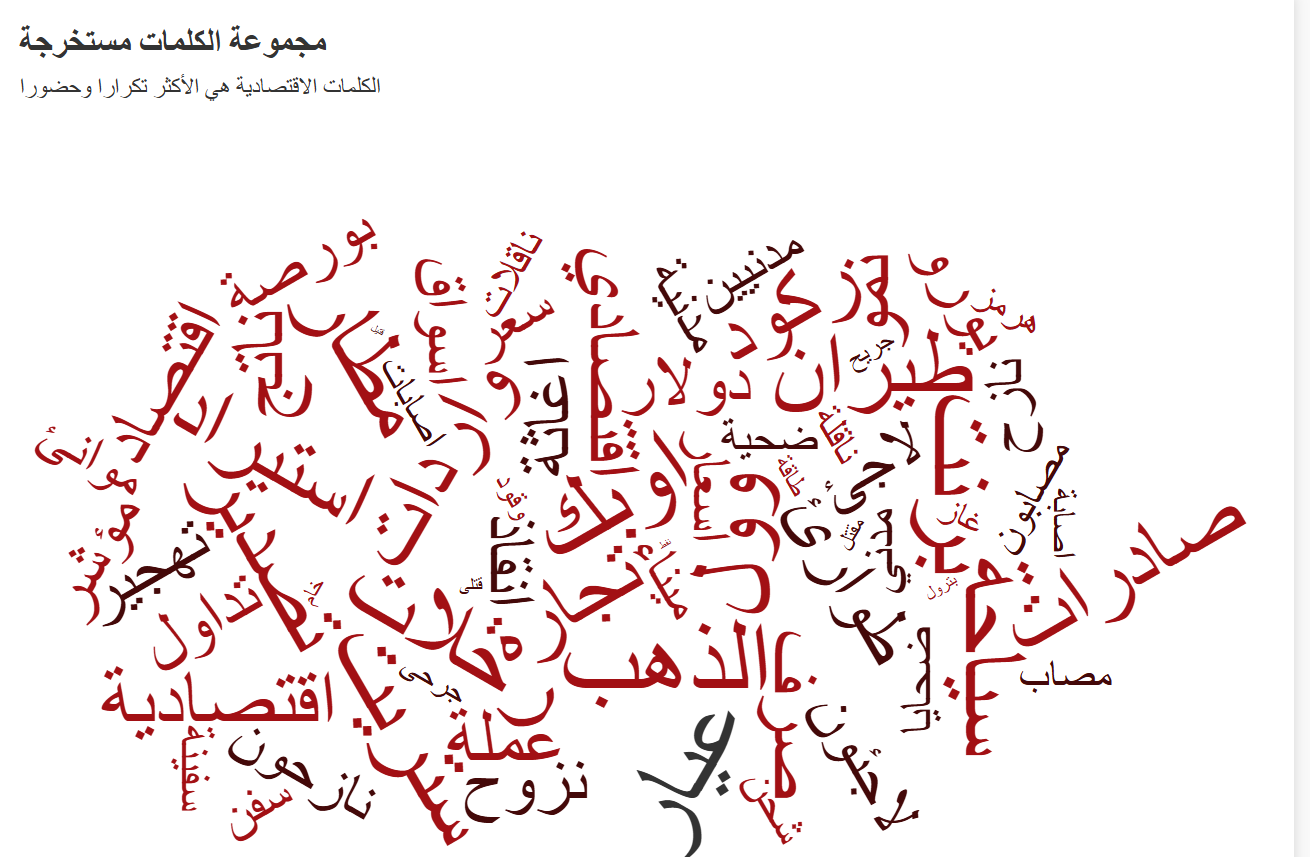
We monitored two distinct lexical categories across headlines and article bodies to analyze this partiality: economic terms—including oil, prices, OPEC, the dollar, gold, Brent, and Hormuz—and humanitarian terms, such as killed, wounded, displacement, civilians, and hospitals.
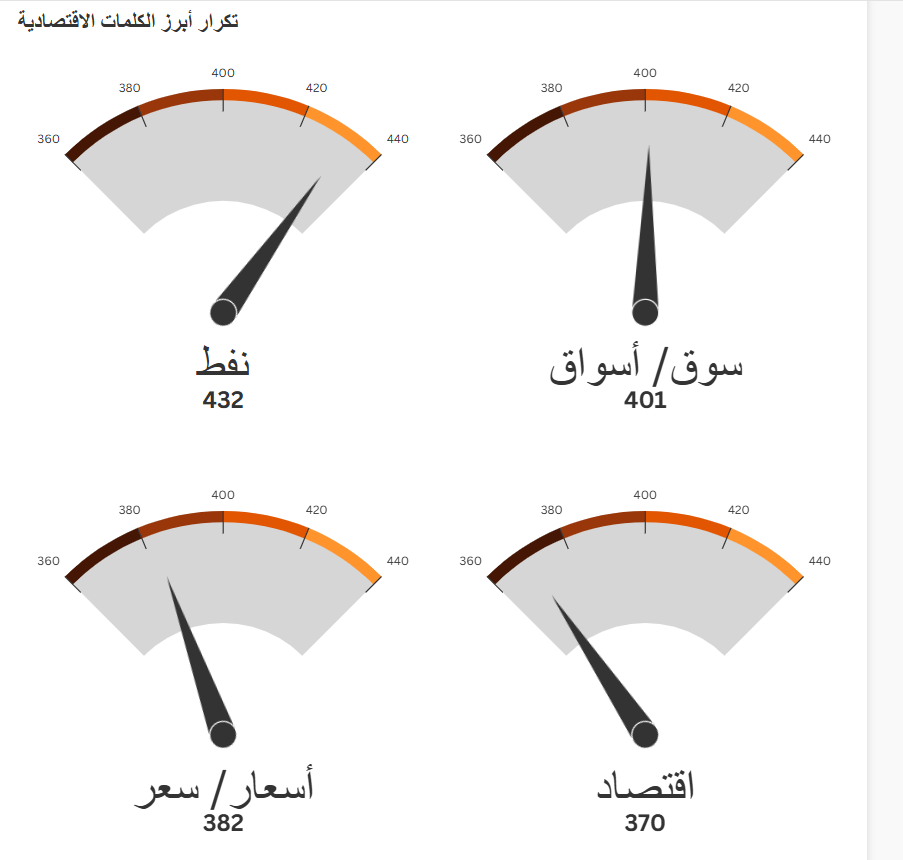
The results showed an intensive presence of economic terms; the group (oil, oily/oil-related...) and its derivatives topped the list with 432 occurrences in headlines, followed by the group (market, markets...) at 401 times, then “prices, price...” at 382 times, and then (economy, economy...) at 390 times in the headlines of all five platforms.
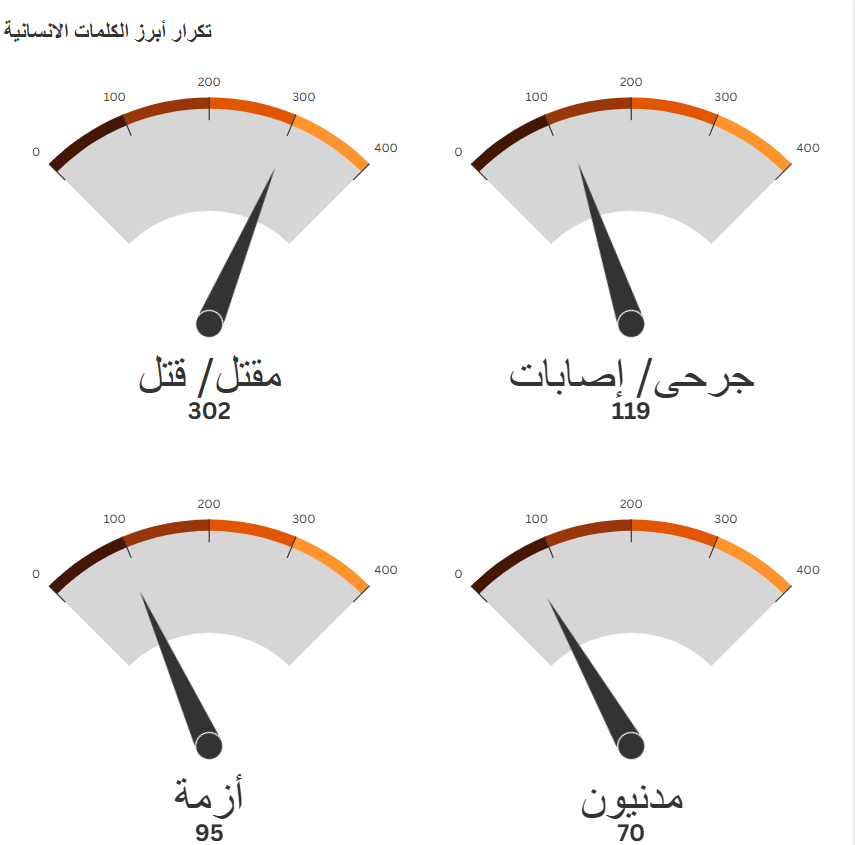
In contrast, humanitarian words were concentrated in relatively smaller word groups; the word “killing/killed” topped the list with 302 occurrences, followed by “injuries/wounded” with 119 occurrences. These figures reflect that economic terms are more widespread, compared to a clear decline in humanitarian vocabulary.
Consequently, a clear contradiction emerged in headlines across all platforms; the total number of economic terms exceeded their humanitarian counterparts by nearly double in all platforms, except for Al Arabiya, where economic terms in headlines outnumbered humanitarian words by nearly four times. This means that for every humanitarian word, there were two or more economic terms in the headlines.
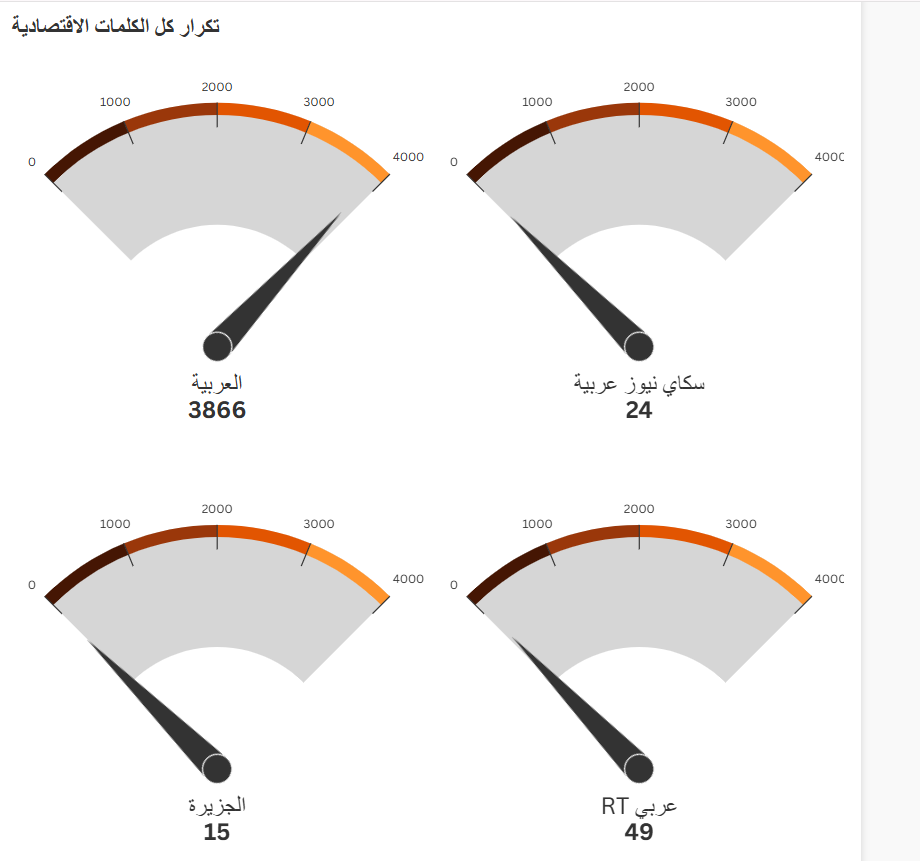
Analyzing the weights for each platform revealed even larger differences; Gulf platforms led this bias, primarily Al Arabiya, Sky News Arabia, and Al Jazeera, who adopted a narrative highlighting the war as an economic crisis more than a humanitarian tragedy.
On Al Arabiya, the ratio of economic to humanitarian language in headlines reached about 5.3:1, and the ratio increased to 6.11:1 in body texts.
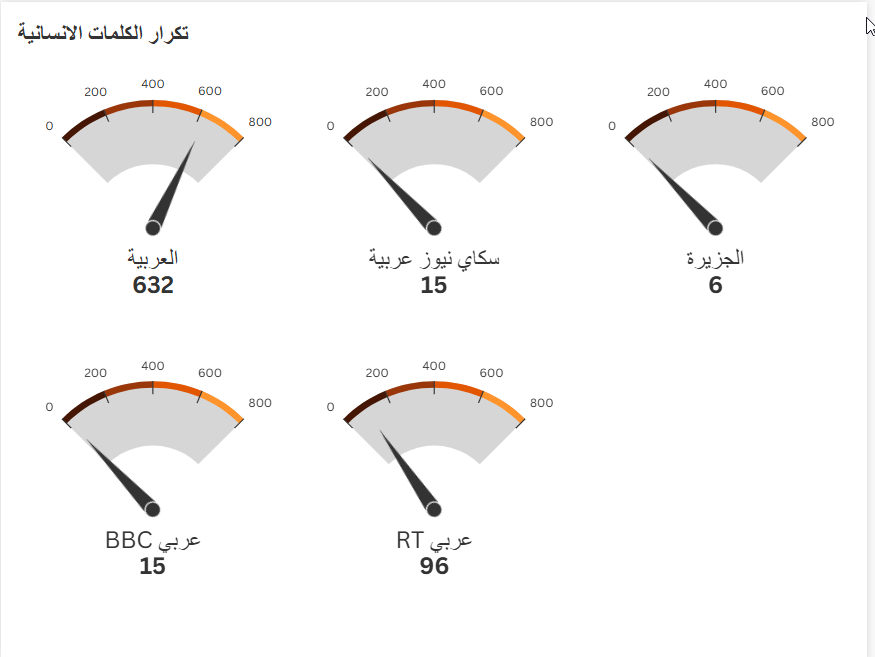
As for Sky News Arabia, the ratio in headlines was 6:1 [sic] in favor of economic language, and it rose in body texts to 2.7:1. The word “economy” and its derivatives were repeated 82 times, and the total of economic terms reached 561, while the total of humanitarian terms (killed, wounded, civilians, hospitals...) did not exceed 207.
In this context, the word “death” emerged as the most frequently used humanitarian term across all platforms, which is a dry descriptive term devoid of any humanitarian dimension. In contrast, more human-centric words such as “children,” “families,” “relief,” and “mass displacement” decreased in body texts.
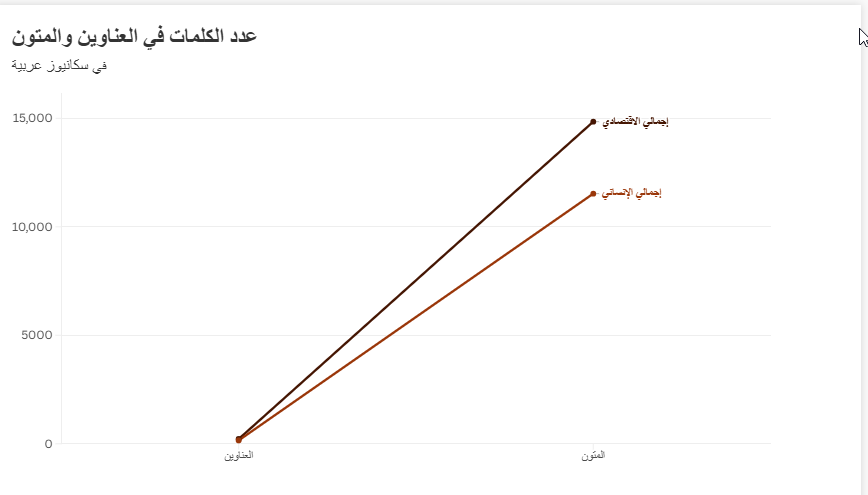
In Al Jazeera’s coverage, despite its fame for field work, the same pattern appeared; the ratio of economic to humanitarian language in headlines reached 2.5:1, while it rose in body texts to 5.19:1, reflecting a clear dominance of economic discourse.
The Support Index: How Priorities are Reformulated within Body Texts
If word frequency reveals what is said, the Support Index clarifies how deeply these words penetrate the coverage. It does not measure the number of repetitions but the probability of the word appearing to the reader while browsing.
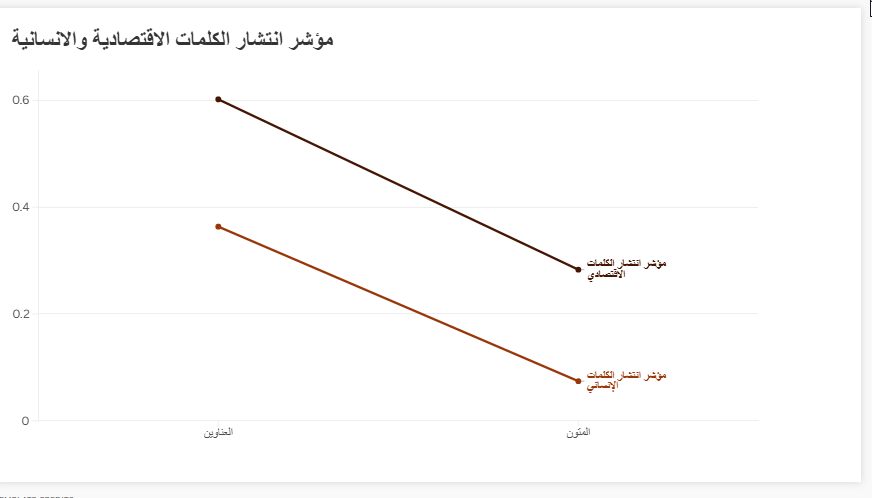
By analyzing the support index across all platforms, a clear gap appeared between headlines and body texts.
In headlines, the coverage maintained a degree of relative balance; the support for economic language reached 0.6019, compared to 0.3635 for humanitarian language. These figures are the sum of the support numbers for economic and humanitarian terms respectively, with a ratio of 1.655845942, meaning that the probability of encountering each humanitarian term in the headlines is met by encountering more than one and a half economic terms.
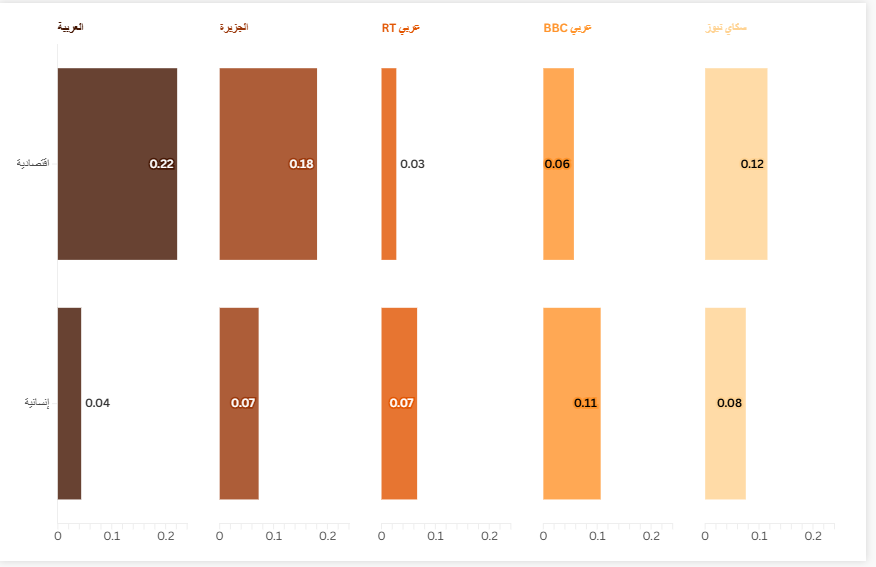
Economic terminology thus accounts for 62% of headline “support” (prevalence), compared to 38% for humanitarian language, establishing a 1.65:1 economic bias.
Even with this prevailing bias, news headlines still featured certain humanitarian language, such as the term "death," which accounted for 0.5% of the total headline aggregate. This appeared alongside significant economic terminology, including "oil" at 0.26% and "prices/price" at 0.23% of the overall word count in headlines.
But the real story is not told in the headlines. When the reader decides to click the link and enter the body of the article, the equation turns upside down. The economic support index rose to 0.2830, while the humanitarian index retreated sharply to just 0.0741.
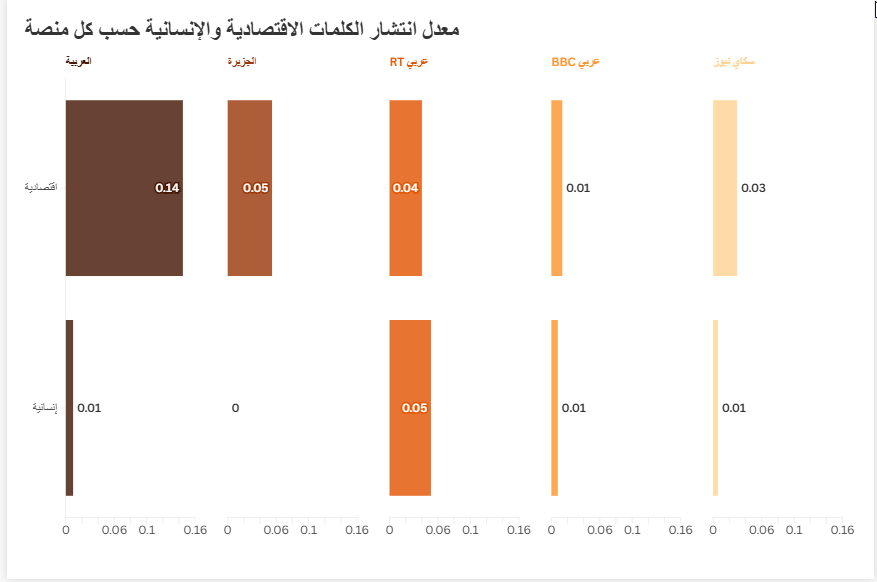
Calculating the ratios, economic terminology captured 79% of the space of prevalence within articles, compared to only 21% for humanitarian terminology. The gap rises from 1.65:1 in headlines to 3.81:1 in body texts—meaning for every humanitarian term, approximately 4 economic term appear in the body text.
What does this gap mean?
This sharp contrast reflects what can be described as Dual Framing, where humanitarian terminology is used in headlines as an entry point to attract the reader’s attention, while the focus is redirected within the body text toward economic issues.
Within the main body of the articles, terminology related to "oil" and its associated forms accounted for 30.2% of all economic support (support = 0.0855), equating to 24% of the combined economic and humanitarian support metrics. In contrast, humanitarian language had largely evaporated; the term "death/dead" stood as a near-solitary survivor, representing 62.5% of total humanitarian support but only 13% of the aggregate total support.
As for the rest of the humanitarian vocabulary, it almost disappeared from the coverage—as “wounded/injuries” recorded a weak support (0.0115), while terms like “hospitals,” “civilians,” “relief,” and “displaced” were entirely absent from the threshold of support in all files.
This analysis reveals that a large part of Arab media coverage, especially on Gulf platforms, presented the war primarily as an economic crisis, where oil topped the scene at the expense of the humanitarian dimension, resulting in media framing where the presence of oil masked the reality of bloodshed, and market fluctuations resonated more strongly than the plight of the victims.
Prepared by: Ibrahim Hilal