Arabi Facts Hub
is a nonprofit organization dedicated to research mis/disinformation in the Arabic content on the Internet and provide innovative solutions to detect and identify it.
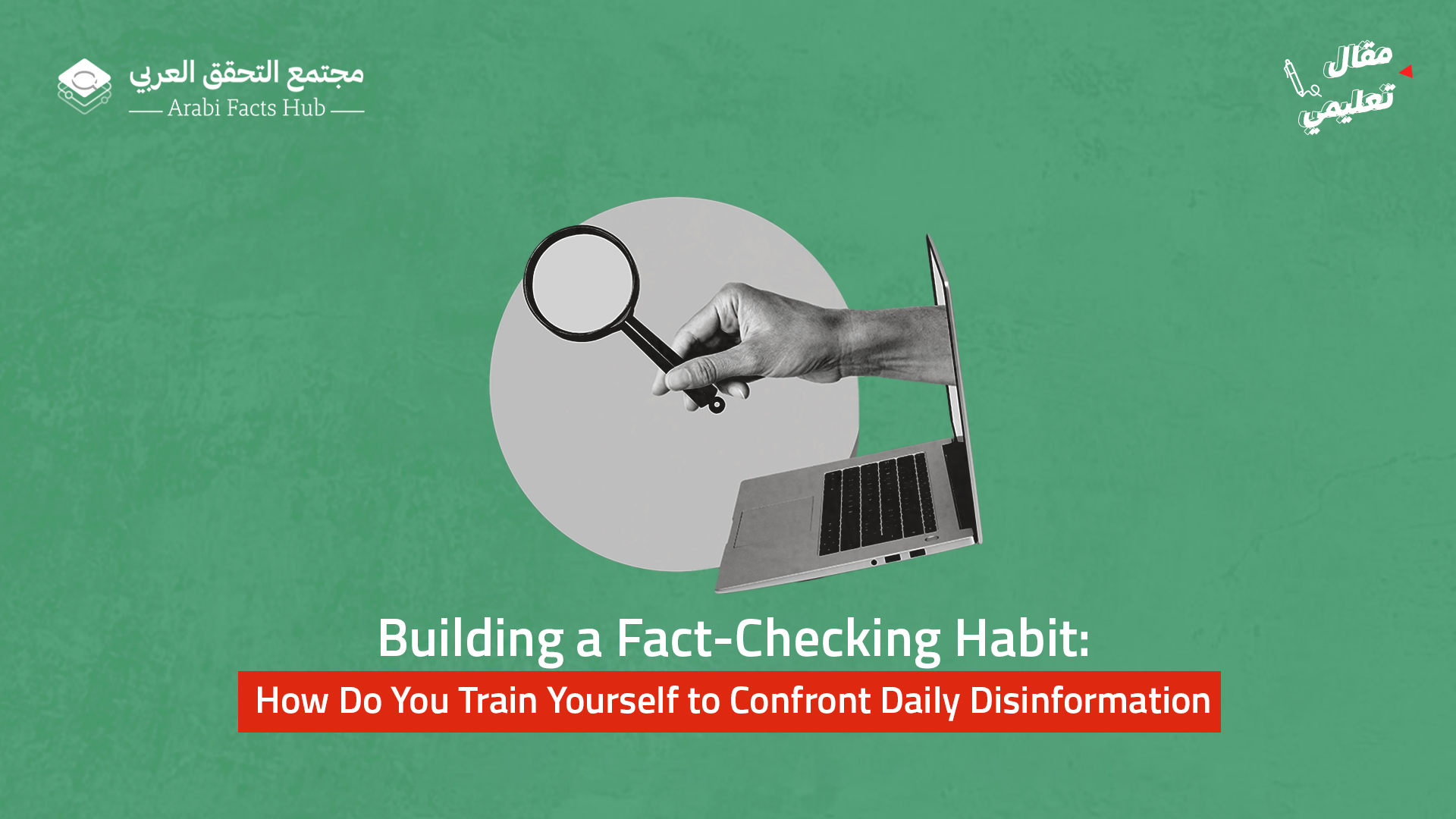
Building a Fact-Checking Habit: How Do You Train Yourself to Confront Daily Disinformation
Nov. 04, 2025 | AFH
Combating disinformation no longer requires technical expertise; it requires a habit. One little habit that begins with a simple question, “Is this true?”
Every time we ask this question before sharing, we choose to be part of the solution, not the problem.
Why Do We Need a Daily Fact-Checking Habit?
In a world where news and posts crowd our screens, verification has become a life skill no less important than reading and writing. Informational chaos is expanding daily, and algorithms promote what evokes emotion over that which affirms the truth. Many assume they are capable of distinguishing what is real from what is false. But studies show that only about 49% always verify before sharing. The other half does not, often sharing content driven by emotion, overconfidence, or even the desire for quick engagement.
Platforms reward the most sensational posts, not the most accurate ones, causing falsities to sometimes spread ten times faster than the truth. Thus, the user, without knowing it, becomes part of the misinformation cycle, not just its victim. The habit of verification is therefore not a luxury, but a necessary daily behavior that restores balance to our relationship with information. Just as we scrutinize our food before eating it, we must review content before sharing it. The difference between those who post spontaneously and those who verify first is the difference between those who reproduce misinformation and those who break its chain.
”
Fact-checking has become a life skill as important as reading and writing.
“
How Do You Start Building a Daily Fact-Checking Routine?
The first step is to start with a decision. Make fact-checking a part of your day, not an urgent task. Ten minutes in the morning or evening is enough to develop this habit.
Start with a simple question before every post: "Does this really make sense? Does it align with what I know?"
This short pause gives you an opportunity to think and research before you react or share.
To help yourself further, you can adopt the famous CRAAP Test, which is a practical measure that assesses the credibility of any content through five points:
- Currency: Is the information timely?
- Relevance: Does it actually relate to the topic?
- Authority: Who is the source?
- Accuracy: Is it supported by clear evidence?
- Purpose: What is the goal of publishing it?
You don't need special tools to apply this test, just pay attention to the source and context.
Simple Tools for Daily Verification
Fact-checking doesn't mean diving into databases or complex tools. There are small steps anyone can take:
- Reverse Image Search: To know the origin of the image and when it first appeared.
- Reviewing Accounts: Check their creation date, number of followers, and post pattern.
- Visiting Fact-Checking Platforms: They provide ready-made reports that can save you effort.
- A Reliable Source List: Keep links to media outlets and fact-checking platforms you always refer to when in doubt.
- A Simple Mental Reminder: Imagine every post in front of you has a button that says 'Stop Before Sharing'.
With these steps, fact-checking turns from a temporary reaction into a daily mental habit.
Diversifying information sources is like looking at a scene from multiple angles. Every platform or media outlet has its own bias or perspective, and when a user relies on only one source, they only see part of the picture.
Studies indicate that individuals who follow more than one platform and compare different coverages develop a higher critical sense and a better ability to verify the credibility of news. Building a 'diverse source system' — which includes independent newspapers, fact-checking platforms, research centers, and specialized pages — is one of the most effective steps to strengthen the daily habit of verification.
Verification is incomplete when we only read one side of the story. Information gains its meaning from context, and context can only be understood by comparing two points of view.
A study titled "Literacy is necessary to understand Fact-Checking" confirms that media and information literacy skills are essential for consciously understanding and evaluating verification processes.
Before sharing any claim, we should pause and ask two simple questions: 'What is the supporting evidence?' and 'Is there a reliable source that presents a different narrative?'
Practicing this step regularly makes fact-checking an automatic habit that doesn't require much effort, but makes a huge difference in resisting daily disinformation.
How Do You Train Yourself for Critical Thinking?
Fact-checking isn't just about tools; it's about a mindset. It is useful to adopt some simple mental approaches:
Start by asking questions: Who said this? When? And why? These three questions are enough to open the door to healthy skepticism.
Read both sides of the story. Even if you lean towards a specific view, try to see what the other party is saying. Cognitive diversity protects you from bias.
Monitor emotional content: News that evokes anger, fear, or pity often spreads faster than facts. When you feel emotional, pause for a moment.
Share your experiences: Tell your friends what you've discovered or verified. Fact-checking becomes stronger and more impactful when practiced collectively.
Studies confirm that users, even those with high digital skills, may share false information because they don't allow themselves time to think. Therefore, "pausing before sharing" is the first line of protection.
”
Share your experiences. Tell your friends what you've discovered or verified. Fact-checking becomes stronger and more impactful when practiced collectively.
“
A Simple Practical Example
Imagine you see a post claiming that "an Arab city has sunk due to a flood."
Before sharing the news, try these quick steps:
- Open the attached image and reverse image search it.
- Read the comments; you might find someone who has already exposed the news as false.
- Check for coverage of the event on well-known news websites.
- If you don't find a reliable source, maintain skepticism and do not share.
In these few minutes, you will have prevented dozens of false shares from spreading.
Benefits of Adopting a Fact-Checking Habit
- Enhancing Trust in Information: You will learn to distinguish between real news and propaganda.
- Reducing Disinformation: Every time you check, you reduce the chance of false information reaching others.
- Building a Responsible Digital Reputation: When your followers know that you only share what is reliable, you will become a trusted source.
- Contributing to Community Awareness: Awareness is not built from the top down only, but by every user who practices fact-checking as a daily habit.
How to Maintain This Habit?
Like any other habit, consistency is key. Set a daily reminder on your phone to dedicate a few minutes to conscious reading, join groups interested in fact-checking, or follow the accounts of fact-checkers.
Over time, you will find that the question "Is this true?" becomes your automatic reaction to every new piece of information.
Fact-checking is not a heavy task or a rare act; it is a habit that anyone can build with practice. Start with small steps, and trust that change begins with individual awareness.
When we learn to pause before sharing, we put a simple barrier against disinformation and open the door to a more mature and responsible collective awareness.
Ultimately, confronting disinformation does not start only with institutions, but with every user who chooses to ask before they share.
Recent Educational Articles

Other Educational Articles