Arabi Facts Hub
is a nonprofit organization dedicated to research mis/disinformation in the Arabic content on the Internet and provide innovative solutions to detect and identify it.
AI-Generated Videos of Settler Attacks Turned Into a Pro-Israeli Accounts Tool to Discredit Palestinian Documentation
Nov. 26, 2026
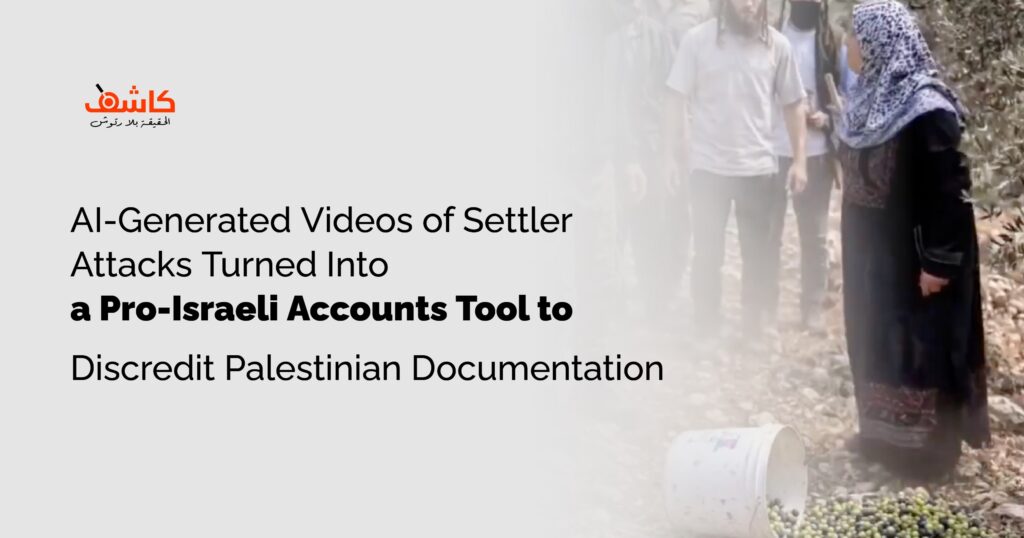


From livestock theft to banana crop looting, irrigation sabotage and attacks on olive pickers: AI-generated videos presented as documentation of Israeli settler attacks in the West Bank, then recirculated by Pro-Israel accounts to portray the Palestinian narrative as a fabricated propaganda campaign.
While the occupied West Bank faces continuous settler attacks targeting Palestinian civilians, their property, and their agricultural land, Kashif has monitored the circulation of AI-generated videos. They show individuals stealing Palestinian livestock, looting banana crops, sabotaging irrigation networks, and assaulting olive pickers, and they are presented as documentation of recent attacks by Israeli settlers.
The problem did not end with the publication of these misleading clips. Accounts that adopt a pro-Israeli-occupation discourse recirculated them and used them to cast doubt on the Palestinian narrative. They portrayed the videos published by Palestinian accounts about settler attacks as part of a propaganda machine that relies on artificial intelligence.
Kashif identified three AI-generated videos circulated across social media platforms. It also traced their reposting and how their use shifted from misleading the public about events on the ground to undermining the credibility of Palestinian documentation.
First: The Livestock Theft Video – Fabricated Scenes Presented as Field Documentation
Three accounts on X circulated a video showing individuals stealing livestock and loading it onto a vehicle. The posts claimed the footage documents settlers stealing Palestinian livestock in the West Bank with the participation or protection of Israeli occupation forces.
Among these accounts was Randy Johnson, who has 5,011 followers. Its listed location is the United States; it was created in 2025, and it posts content on the Palestinian cause and international issues. The account captioned the clip: "The Israeli army (IDF) is complicit in the theft of livestock belonging to Palestinian residents by Israeli settlers in the West Bank."
The account Safa Barakat, which has 2,445 followers, also lists the United States as its location and was created in 2025. It published the same clip, claiming it shows extremist settlers stealing Palestinians' livestock "under the supervision and protection of occupation forces."
The account Abu Hussien Al_Hlawey, which has two followers, reposted the same video. Its listed location is Iraq, and it was created in 2024. It posts religious and political content alongside AI-generated clips.
To identify the earliest source, Kashif found that the Facebook account Puguh Andrianto published the video on 22 November 2026. The account describes its owner as a digital content creator. It has roughly 114,000 followers, its listed location is Indonesia, and it publishes AI-generated content.
Notably, Facebook labeled the video on that account as AI-generated. That label was absent from some of the posts that recirculated it and presented it as genuine documentation of attacks in the West Bank.
Note: The location shown in an account's data does not necessarily mean the owner actually resides in that country. It may be linked to technical information, SIM card data or a phone number, and it is not conclusive evidence of the user's place of residence or nationality.
Kashif examined the clip and concluded that it was generated using artificial intelligence, based on a set of visual indicators, chiefly:
- Clear distortions in the features of some of the livestock, with the head of one animal appearing suddenly during the scene.
- Livestock passing through wire fencing in an illogical and unrealistic manner.
- Livestock changing shape and becoming distorted as they are placed into the vehicle.
- Visual details that are inconsistent and change between shots.
In addition, the Hive Moderation tool indicated a 99.9% probability that the clip is AI-generated.
Second: The Banana Looting and Irrigation Sabotage Video
In another clip, accounts on social media circulated a video showing people picking bananas from agricultural land and tampering with an irrigation network. It was accompanied by claims that it documents Israeli settlers stealing banana crops and sabotaging irrigation networks on farmland in the West Bank.
The video was published by Misk Palestine, which has 27 followers, lists Turkey as its location, was created in 2026, and posts content related to Palestinian affairs. It carried the claim: "Israeli settlers steal banana crops and sabotage irrigation networks on agricultural land in the West Bank."
The account Al-Radea Al-Turki, which has about 571,300 followers, lists Turkey as its location and was created in 2018, also published the clip on X. Its caption accused settlers of looting a Palestinian banana farm and destroying its irrigation system.
In tracing the earliest postings, Kashif found that the account DONT STOP published the clip on TikTok on 12 November 2026. The account has 3,517 followers, posts content on Palestinian and international affairs, and has previously published AI-generated clips.
Kashif examined the video and concluded that it was AI-generated after identifying unnatural visual indicators, including:
- Distortions in the fingers of the people in the video.
- The people's hands blending into the banana trees as they pick the crop.
- A mismatch between the movement of the hammer and the blows directed at the water pipes.
- Water flow from the pipes stopping even as they continue to be tampered with.
- Pipes changing nature and becoming distorted so that in some shots they appear flexible, although they should be rigid.
Hive Moderation results indicated a 99.8% probability that the video is AI-generated.
Third: The Video of Settlers Assaulting a Woman While Picking Olives
The account Randy Johnson on X published another AI-generated video showing settlers assaulting a woman. It claimed the video documents a group of settlers attacking a woman while she was picking olives. More than 400 people reshared it with the caption: "Israeli settlers once again attack olive farmers in the West Bank." The account has 5,011 followers, lists the United States as its location, was created in 2025, and posts content on the Palestinian cause and international issues.
The account Puguh Andrianto was the earliest instance Kashif could find; it published the video on 24 November 2026, noting on Facebook that it was AI-generated.
Kashif verified the video and found it was generated with AI, as shown by several distortions, chiefly:
- Changes in the woman's features between the beginning and end of the clip.
- A change in her body shape, appearing slim at first and fuller later.
- Her shoes changing color from white to black.
- A distortion in one of the settlers' hands.
- The people's movements appearing unrealistic.
AI-content detection tools, including Hive Moderation, also indicated a 99.9% probability that the video is AI-generated.
The video was inspired by a real incident documented on 23 November 2026, in which a group of settlers attacked Palestinian women and a family while they were harvesting olives in Masafer Yatta, south of Hebron.
From Publishing the Fake Video to Accusing Palestinians of Fabricating Attacks
The repercussions of the video's circulation did not stop at its presentation as documentation of settler attacks. It moved into another context when accounts adopting a pro-Israeli-occupation discourse recirculated it. They used it to cast doubt on the credibility of Palestinian content and to claim that Palestinians use artificial intelligence to fabricate scenes of attacks in the West Bank.
One example is a post by the account Rabbi Poupko on X, which recirculated the banana looting and irrigation sabotage video with the comment:
“Another AI video of "settler violence"going viral and reaching hundreds of thousands of vulnerable minds who cannot tell the difference between reality and fiction.
What would the anti Israel propaganda machine do without AI?”
This post recirculates the banana video and extends the accusation of AI use to the entire Palestinian propaganda machine.
In another post, the account James J. Marlow addressed the same video. It wrote that an AI-generated clip was circulating on social media, presented as documenting Israeli settlers stealing Arab bananas and smashing irrigation pipes and networks. The account said the video is fake and asked: "It’s fake and I ask the question again - if this is really happening, why the need to make this fake AI-generated nonsense”.
The account did not stop at noting the video's falsity. It used it in a broader political context, calling it "the same demonisation techniques were used 90 years ago in Europe by the haters. May not have been Ai then, but the false testimonies, opinion pieces in newspapers and speeches in front of tens of thousands influenced tens of millions”.
These posts show how a single AI-generated clip can move between contexts. It begins by being published as documentation of a field incident, is then exposed as fake, and is then redeployed in a broader discourse that attacks the credibility of Palestinian content.
Notably, both accounts went beyond pointing out that the clip is fabricated, a fact established by verification. They moved from exposing the falsity of one specific video to issuing judgments and generalizations about Palestinian documentation. This reached the claim, made by Rabbi Poupko, that 90% of the Palestinian propaganda machine relies on AI.
These two posts are only examples of dozens of accounts that Kashif has observed circulating and repurposing AI clips in this way. The effect is to turn fabricated content from a tool for misleading the public about a specific incident into a tool for casting doubt on the Palestinian narratives about Israeli attacks and violations.
From the West Bank to Gaza: The Tent Flooding Incident During the Weather Storm
This pattern is not limited to videos related to settler attacks in the West Bank. In early November 2026, the Gaza Strip was hit by a weather storm with heavy rain that flooded displaced people's tents. Palestinian, Arab and international media outlets published reports on the flooding and the dire humanitarian conditions facing the displaced. At the same time, accounts supportive of Israel, including GAZAWOOD, published AI-generated videos of flooded tents on social media. They claimed that Gaza's residents were fabricating reality and that no flooding had occurred in the Strip as a result of the rain and the depression.
For example, GAZAWOOD published an AI-generated video that the account BOSH reposted on X. It claimed that Gaza's residents were publishing AI-generated videos of flooded tents to raise money and donations, adding: "Palestinians use AI-generated clips to fool the herd and to collect money and donations."
Kashif produced a report on GAZAWOOD's disputing the tent flooding in the Gaza Strip.
The pattern thus extends from Gaza to the West Bank. Fabricated clips are first circulated as documentation of events affecting Palestinians, then become material exploited by other accounts to cast doubt on the authenticity of Palestinian documentation and to present it as part of a propaganda campaign.
This does not mean that every account that reposts a fake clip necessarily stands behind its production or knows its source. However, redeploying it in a generalizing discourse after learning that it is AI-generated opens the door to another kind of disinformation, one that goes beyond the video itself to cast doubt on real events.
Real Attacks That Need No Fake Videos
These clips emerge at a time when the West Bank is witnessing documented attacks on Palestinian civilians, their property and their agricultural land.
On 4 November 2026, settlers stole the banana crop and sabotaged the irrigation network on farms in the Al-Masoudiya area, northwest of Nablus.
On 17 November 2026, various parts of the West Bank also saw an escalation in settler attacks on civilians and their property. These included beatings, pepper spraying, the theft of livestock and personal belongings, raids on villages and the pursuit of shepherds.
Here the paradox emerges. While real incidents of settler attacks are well documented, AI-generated scenes are circulated as documentation of those attacks and then repurposed to cast doubt on Palestinian documentation as a whole.
Recent News